
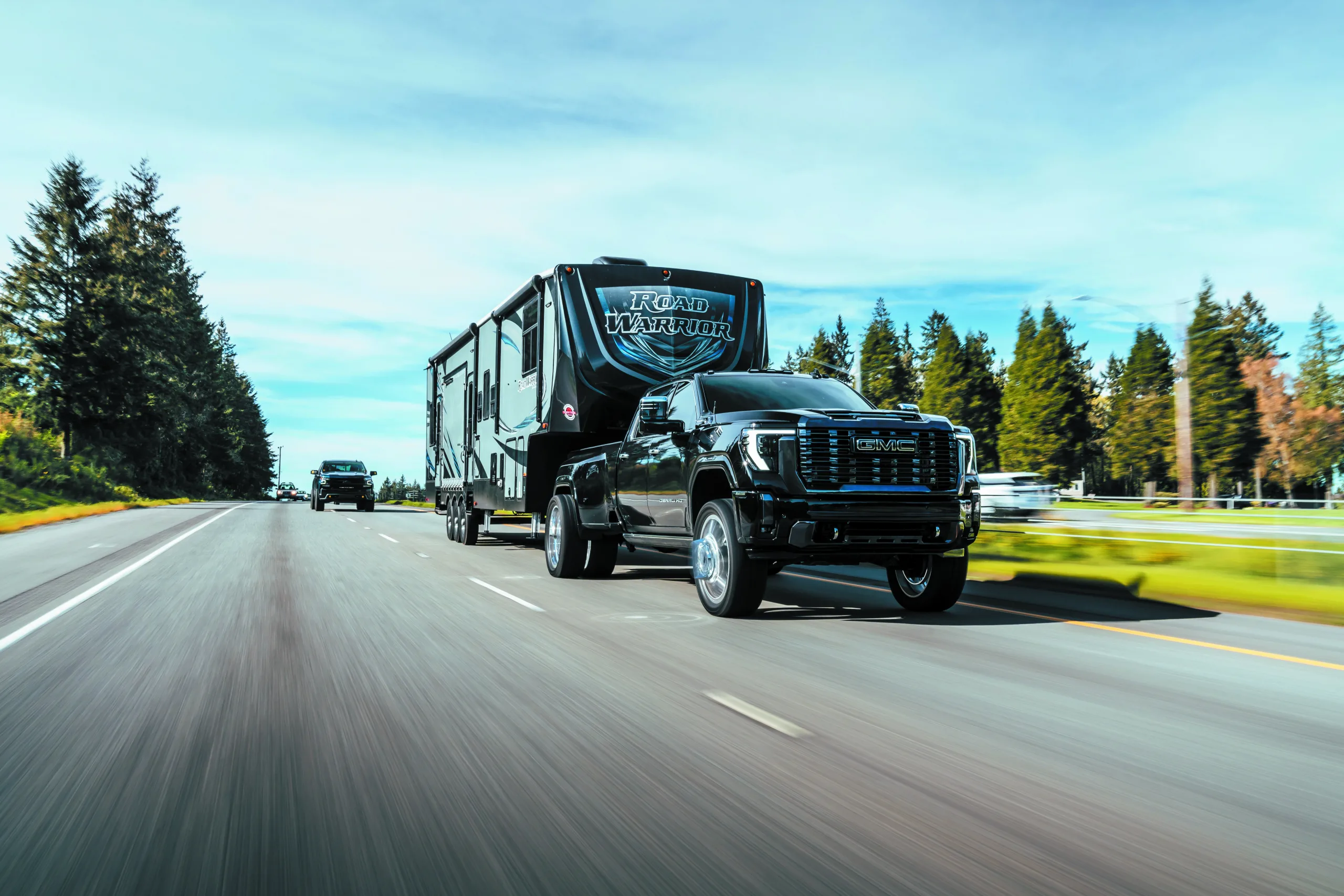
Tips for correctly matching your tow vehicle and trailer, understanding weight capacities, choosing a hitch system, and more.
By Chris Hemer
July-August 2026
Today, many buyers shopping for RVs are finding travel trailers and fifth wheels to be attractive options. These vehicles promise family adventures and also satisfy our pragmatic side: The truck or SUV needed to tow one can serve as a commuter throughout the week and a runabout during vacations while the trailer is parked. And because many families already have a suitable tow vehicle in the driveway, RVing by a trailer becomes even more appealing.
However, creating the ideal tow vehicle/trailer combination can be daunting. Balancing your needs and wants with what a vehicle is engineered to tow requires a little homework, especially if the whole family will be traveling. However, once you have a basic understanding of tow ratings and weight capacities, finding the right tow vehicle and trailer (or both) will become easier.
THE TOW VEHICLE
If you’ve already got a truck or SUV and you’d like to find a trailer that’s a good match, the first step is to determine your vehicle’s tow rating (if you don’t know it already). Most vehicles designed for towing list this information in the owner’s manual under “towing” or “trailer towing,” and the rating may vary depending on how the vehicle is equipped. Factors that may influence the tow rating include the engine/transmission, drive system (RWD/FWD or 4WD/AWD), the final drive ratio, and whether or not it was ordered with a towing/payload package. Owner’s manuals for most popular brands built in the last 10 years or so are also available for free online. To find one, simply enter the make and model of the vehicle in your favorite search engine, followed by “owner’s manual.” Most of the time, this will lead you to an owner’s site, such as chevrolet.com/support/vehicle/manuals-guides.
If you can’t find the tow rating in your vehicle’s manual or online, a dealership service department should be able to help you by looking up the Vehicle Identification Number, or VIN. It’s important to find the tow rating for your specific vehicle and the way it’s equipped. The towing calculators or formulas available online may only display the highest available tow rating for a given model and don’t break down tow ratings based on your vehicle’s specific equipment and/or options.
Another important consideration is the tow vehicle’s payload rating, which is calculated by subtracting the vehicle curb weight (the total weight of the vehicle with standard equipment, full of fuel and necessary operating fluids, but without passengers or cargo) from its gross vehicle weight rating, or GVWR. The payload isn’t just how much stuff you can carry, it’s the maximum allowable weight for both cargo and passengers. This is important information that can also affect what the vehicle will be able to tow. The payload capacity of the vehicle can be found on a “Tire and Loading” information decal inside the doorjamb or edge of the driver’s door, or in the vehicle owner’s manual.
If you plan to shop for a new tow vehicle, the process of finding the tow rating and other weight-related info has gotten a lot easier. For years, Ford led the charge with its “RV & Trailer Towing Guide” and still offers it online in PDF format — with tow ratings for every model. It also contains a plethora of other useful information related to weight, towing, safety, equipment, and more. GM now offers similar information in its Chevrolet “Trailering Guide.” Ram provides online towing information for its trucks. If you search “2026 Ford Towing Guide” (or similar wording for Chevrolet or Ram), you should find what you’re looking for, and they’re free. Other brands may not offer as much information on towing as the Big Three, but again, you may download the owner’s manual from most owner sites, or have the dealer look up the tow rating and other info for you.
TRAILER SHOPPING
Once you know the vehicle’s tow and payload ratings, you can get to the fun part: finding that perfect trailer. As you might have guessed, the first and most important consideration is how much your dream trailer weighs, whether it’s a travel trailer or a fifth wheel. All trailers should have a label that displays the GVWR, the unloaded vehicle weight (UVW), and the cargo carrying capacity (CCC); the latter is established by subtracting the UVW from the GVWR. It’s important to note that the UVW may vary depending on how the trailer is equipped, and you can’t determine its actual weight until it’s full of water, propane, and all supplies you normally carry (see the “Weighty Issues” section for specific information).
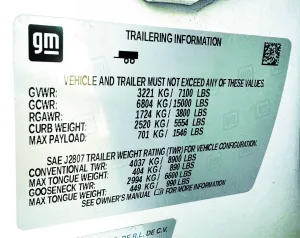
Your tow vehicle’s towing and payload information can often be found on labels inside the driver-side door or in the owner’s manual.
Whether you’re shopping new or used, you probably won’t have the opportunity to weigh the trailer in its loaded condition before purchase, so your safest bet is to use the trailer’s GVWR as your guide. As with the tow vehicle, the GVWR represents the maximum allowable weight, so, if the trailer GVWR is within the tow vehicle’s maximum tow rating, you should be fine. Also, since it’s unlikely you will load the trailer to its maximum (though it is possible), using the GVWR as your guide can help you make sure that the tow vehicle has capacity to spare. Ideally, you want a margin of 10% or better between the trailer’s GVWR and the tow vehicle’s maximum tow rating. For example, if your vehicle has a max tow rating of 17,000 pounds, you’ll want a trailer with a GVWR of about 15,000 pounds to ensure adequate performance and handling.
Keep in mind that a travel trailer places at least 10% of its weight on the vehicle’s hitch (known as hitch or tongue weight), while a fifth wheel will put around 20% of its weight in the bed of your truck (known as pin weight). Calculate that figure on the trailer you’re considering as if it were at maximum weight, then add up the passengers and typical cargo, and make sure the payload rating won’t be exceeded first.
The next thing to consider is the vehicle’s gross axle weight rating (GAWR), which is the maximum weight the tow vehicle’s axle is designed to carry. Unless you plan to haul a lot of weight in the bed of the truck, GAWR usually isn’t a concern with a properly matched travel trailer. However, because fifth wheel trailers carry more weight in the bed, directly over the rear axle, it’s even important to make sure the GAWR is within range.
Yes, it’s a lot. But once you get all this down, you’ll have peace of mind knowing your tow vehicle is up to the task and not overloaded.
ALREADY HAVE THE TRAILER?
Sometimes, buyers already own a trailer or may want to find the perfect new model before they select a tow vehicle. Again, it’s important to consider what ratings and specs the tow vehicle will be required to have. Simply put, the heavier the trailer, the more capable the tow vehicle will need to be.
A bigger, more powerful engine option; a heavy-duty towing/payload package; and factory towing aids will raise the tow vehicle’s price tag. And if you’re shopping for a fifth wheel, you’ll need to pair it with a heavy-duty truck or dually. Consider how comfortable you and other drivers will be piloting this type of vehicle on the highway, in the city, or as a second family vehicle. These lengthier trucks require more room to turn and can ride relatively rough when they’re not towing/hauling anything (duallies especially). They are also more expensive than light-duty trucks, get poorer fuel economy, and may cost more to maintain.
That being said, focus on finding a tow vehicle that can safely tow the trailer you have or want to purchase. For example, if the trailer has a GVWR of 20,000 pounds, you’ll want a vehicle that can tow at least that much — preferably more (remember the 10% margin). You’ll also want to check out the tow vehicle’s GVWR, GAWR, payload, and GCWR (gross combined weight rating, the maximum allowable weight of the truck and trailer).
Usually, a vehicle with a sufficient tow rating will also have enough capacity in these other areas, but not always. For example, a half-ton truck may be rated to tow more than 12,000 pounds, but a fifth wheel weighing that much may exceed the payload and/or GAWR of the truck.
TRAVEL TRAILER HITCHES AND HITCH RATINGS
An integral part of a hitch system is the hitch receiver, a square, tubular box located underneath the bumper that is attached to the frame or subframe of the tow vehicle. If your tow vehicle doesn’t have one, it probably wasn’t intended for towing, although that’s not always true. Some models are only equipped with a hitch receiver if an available tow package was specified; other small SUVs or crossovers may offer a hitch receiver as an accessory at the time of purchase. In that case, the appropriate hitch receiver can often be added by the dealer or qualified towing/RV center, but first check with the vehicle manufacturer to make sure that installing one on your vehicle is approved and safe. Some vehicles don’t have adequate structure underneath to allow one to be attached.
Hitch receivers are categorized in classes: Class I being the smallest, light-duty receivers and Class V being the largest and strongest. Smaller, lighter receivers are designated as weight carrying, meaning all the trailer’s hitch weight (also known as “tongue weight”) is carried by the hitch itself. These hitches usually attach to the bumper or vehicle frame. The larger hitch receivers (Class III and up) can either be weight carrying or weight distributing, meaning they are intended to be used with hitch bars (or “draw bars”) to distribute some of the trailer’s hitch weight to the front of the vehicle.
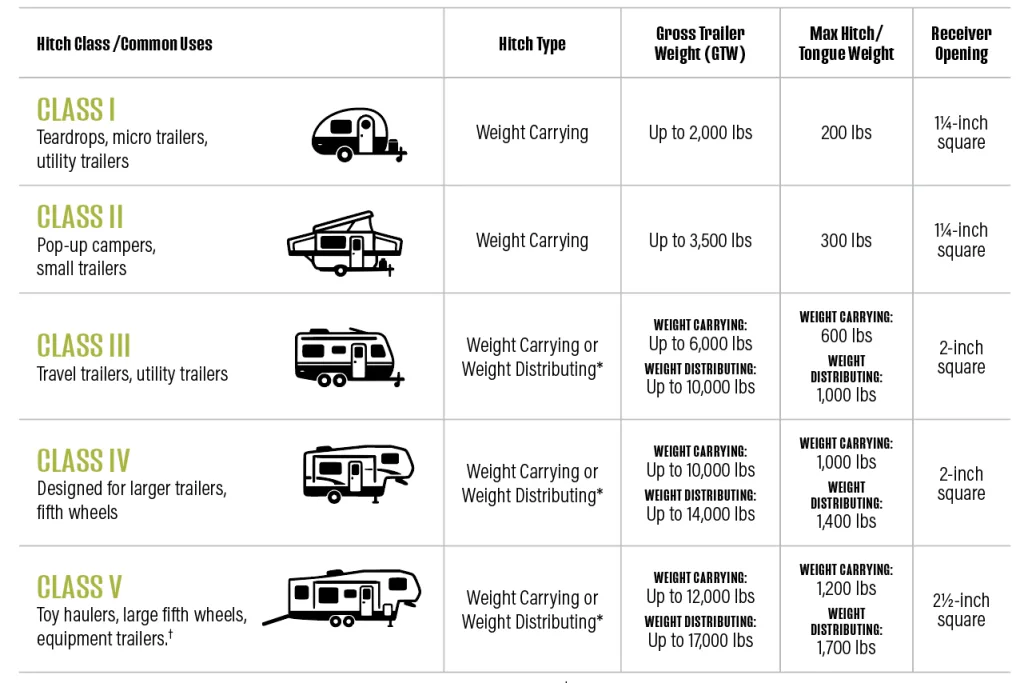
Note that receivers may have the same size opening but are rated differently. When in doubt, take a closer look at the receiver; it should have a stamp or label that details its capacity(ies).
Purchasing and setting up a weight distributing hitch system on a travel trailer is another story unto itself, but a dealer or a reputable RV center should be able to help you choose the right hitch system and set it up properly.
FIFTH WHEEL HITCH SYSTEMS
In RVing’s earlier days, selecting a fifth-wheel trailer and hitch setup was considered a serious commitment. A structure had to be fabricated and attached to the truck’s frame for the hitch system to mount to, which often involved significant labor charges in addition to the cost of the hitch itself. Today, heavy-duty pickups (2500 and 3500 models) that are “fifth wheel prepped” are commonplace; they utilize so-called puck mounting systems, with the holes already drilled in the bed, and sockets incorporated into the frame rails that can accept unique fasteners. Now, it’s simply a matter of installing the hitch, locking the fasteners in place, and heading down the road.
Some truck manufacturers or dealerships may offer models already outfitted with a fifth wheel hitch — a consideration if you just want to connect your trailer and go. However, it’s a good idea to shop a variety of hitch systems, for several reasons. If you’re on a budget and/or plan to tow infrequently, you may opt for a less expensive hitch that will safely do the job. If you plan to tow frequently or will be hauling a heavier trailer designed for full-time use, you may want a hitch with air ride or some other suspension system; it will cost significantly more but will offer smoother operation and a more comfortable ride. In addition, some hitch assemblies are lighter than others; still others can be assembled/disassembled in sections, making installation/removal easier (or at least possible) for one person.
Unlike travel trailer hitches, which are broken into classes, fifth wheel hitches are simply designated by the maximum weight of the trailer (the GTW, for which they are designed ). A 16,000-pound (or 16K) hitch is rated for up to 16,000 pounds GTW; a 20K hitch is designed for a GTW up to 20,000 pounds.
Because you won’t necessarily know the weight of your trailer once it’s filled with fresh water, propane, and supplies, it’s a good idea to base your hitch purchase on the trailer’s GVWR — and always “buy up.” For example, if your trailer has a GVWR of 18,000 pounds, search for a 20K hitch.
More often than not, fifth wheels are pulled by full-size, heavy-duty (2500 or 3500) trucks with 8-foot beds, so there is adequate room for the front of the trailer (called the “cap”) to clear the cab of the truck when navigating a sharp turn (around 90 degrees). It is possible to tow a fifth wheel with a truck that’s equipped with a 6-foot bed, using the correct hitch. However, we would recommend starting with an 8-foot bed, as fewer compromises and special equipment will be required. Again, a dealer or good RV center can help you install your fifth wheel hitch, ensure it’s properly adjusted at the correct height, and show you how to use it properly.
FIFTH WHEEL HITCHING TIPS
When hitching a fifth wheel, one positive is that you can watch the pin as you back it into the hitch, which you can’t do with a travel trailer coupler and hitch ball unless you have a camera system. On the negative side, there’s not much room for error with a fifth wheel; if the trailer is too high, too low, or off-center by even an inch, you won’t be able to hitch up successfully.
When hitching up a fifth wheel, first raise the landing gear (or leveling system) to a height that is level with, or just below, the hitch saddle. Lower the tailgate on the truck; hang the power cord where it won’t be in the way; then slowly back up, guiding the pin into the hitch. If you did it right, you will hear a satisfying “clunk!” as the pin finds its home. Just before the hitch is in place, stop and check the pin height relative to the hitch; if you see a gap between the two, lower the trailer until the pin box and hitch touch (or even a little more), then back the rest of the way in.
It’s important to note that fifth wheel hitches use latching jaws, many of which are designed to lock in place around the pin automatically. However, this may not always happen, so always make sure the hitch’s handle is in the locked position; then, go around the back of the truck and visually verify that the hitch jaws are closed around the pin. Then, and only then, should you close the tailgate, plug in the power cord, connect the breakaway cable, and raise the landing gear/leveling jacks. If you forget to make sure the hitch jaws are locked, the trailer will fall onto the truck, causing severe damage to both vehicles. If the hitch handle has a provision for a padlock to secure it in the locked position, use it. If you’ve been away from your rig, it’s also a good idea to check that the hitch jaws are still locked upon your return.
WEIGHTY ISSUES
Earlier, we discussed the importance of your vehicle’s tow rating and how you can find it, along with GAWR, GVWR, GCWR, CCC, and payload. Although these manufacturer’s figures are crucial for safe towing, determining the actual weight of your truck/RV combination is always a good idea also. Weighing the RV when it is full of water, propane, and all necessary supplies will provide you with the actual, not stated, base weight as well as the actual hitch or pin weight — important when making sure the tow vehicle’s payload and GAWR have not been exceeded. It can even sort out problems you may be having with your individual setup.
For example, perhaps your trailer suffers from sway at a certain speed, which could indicate an insufficient hitch weight. Knowing the actual weight will help you find out for sure, after which you can shift cargo forward or travel with a full freshwater holding tank (usually located ahead of the rear axles), placing more weight on the hitch.
Knowing the actual weight will also tell you how much margin is left before the trailer/tow vehicle is overloaded — handy info for a long trip when you may want to travel with additional gear or supplies. Obtaining your trailer’s actual weight is not difficult or expensive, either.
CAT offers a network of certified scales at truck stops, travel plazas, and fuel stations nationwide. The CAT Scale Locator app can help you find the scale nearest you, and their Weigh My Truck app lets you complete the whole process using your smartphone. The price typically ranges from $13.25 to $15.25, and a re-weigh at the same location within 24 hours will typically cost between $4 and $5.25.
Because you want the actual weight of your rig with all fuel (including propane, water, gear, and passengers), head to the scales when you’re actually packed for a trip. From our experience, the least busy time to visit the scales is in the early afternoon, as most truck drivers have either left a long time ago, or won’t be back for a few hours. Find a place to park your rig, then visit the front counter to tell them you’d like to weigh your truck and trailer and get <I>two<I> weights: one for the truck and trailer, and one for the truck only. Tell them that you will be disconnecting the trailer after the first weight to get a re-weigh on the truck only and ask them to suggest a good place to park your trailer (some truck stops get edgy when they see someone leave a trailer on their lot).
CAT scales (as well as some others) have three distinct platforms on them; essentially, they are three scales in one. Pull onto the scale and position the tow vehicle’s front axle on the first platform (all the way at the front), the rear axle on the second (middle), and the trailer axle(s) on the third (rear). This will give you the gross combined weight of the truck and trailer, the front/rear tow vehicle axle weights, and the trailer axle weight.
Disconnect the trailer, then drive onto the scale with the tow vehicle, positioning the wheels as you did before. Use the intercom to remind the weighmaster that this will be your re-weigh, or use the Weigh My Truck app on your smartphone. This re-weigh will provide the truck’s actual, ready-for-travel weight and individual axle weights without the trailer. With this information, you can calculate the tongue/pin weight of the trailer by subtracting the total truck weight without trailer from the truck-with-trailer weight.
For more information about weighing at CAT facilities, visit catscale.comor you call (877) 228-7225.
There’s little doubt that pairing a truck and trailer correctly takes some time and research, but doing your homework ahead of time will ensure reliable travel and peace of mind.
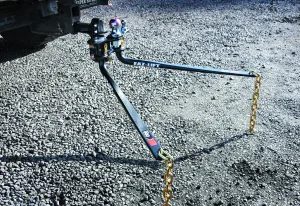
LET’S GET HITCHED
Correctly setting up a travel trailer for towing eludes many RVers. Any time you travel the highway, you’ll likely see a tow vehicle with the rear sagging and/or the back of the trailer angled upward. To the uninitiated, these characteristics might suggest the tow vehicle is pulling too much weight (and it could be), but it is more likely the owner never learned how to properly set up the hitch.
As mentioned in the main text, there are two types of travel trailer hitches: weight carrying and weight distributing. Weight carrying hitches offer little in the way of adjustment other than being able to raise or lower the hitch ball. By contrast, weight distributing hitches can be adjusted a multitude of ways: You can raise or lower the ball mount and/or adjust its angle, while the draw bar tension can be increased or decreased to achieve the correct weight distribution — in other words, a level tow vehicle and trailer.
Getting all this right may seem difficult, but it’s just a simple matter of purchasing the correct weight distributing hitch for your application (a reputable RV center or hitch manufacturer can assist), doing a little measuring, and assembling the hitch system.
While weight distributing hitches come in a variety of designs, what follows are the basic stops for a traditional setup on a travel trailer and ¾-ton pickup.
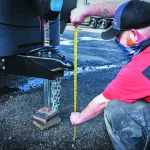
1. Measure the height of the trailer at its center, as this is the most level point.
2. Measure and adjust the coupler height to match.
3. Install the hitch shank into the receiver and insert the pin and safety clip. This hitch shank has multiple adjustment holes to raise or lower the ball mount as needed.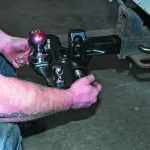
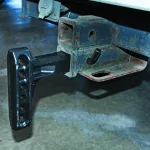
4. Install the ball mount, then measure the ball height and adjust up or down as needed to match the trailer hitch coupler. When satisfied, insert the mounting hardware and fully tighten, per instructions.
CONNECT HITCH SYSTEM
5. Apply a moderate amount of grease to both the hitch ball and the draw bar sockets.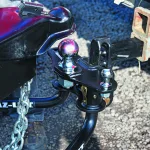
6. Back the tow vehicle up to the trailer, leaving adequate room to install the draw bars into the hitch head sockets.
7. Install the draw bar saddles on the trailer, but do not tighten them yet. You may need to move them forward or back during the setup process.
8. Back the tow vehicle up and have a helper tell you when the hitch ball is aligned. Lower the A-frame jack until the coupler slides down over the ball.
9. With the coupler locked into place over the ball, use the A-frame jack to raise the tow vehicle and trailer enough to take the weight off the hitch — usually just a few inches.
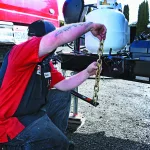
10. Raise the end of the draw bar with the attached chain (if so equipped) and count the number of links it takes to make the bar level, as shown. In this case, the bar was level on the eighth link from the bottom.
11. Attach the link (the eighth one in this example) to the hook on the saddle, then raise all the way up. This is done with a bar that comes with the hitch, where applicable.
12. Once the bars are lifted all the way up, insert the safety pins to prevent the bars from snapping back down, as they are under significant tension.
13. Fully tighten the saddles to the frame.
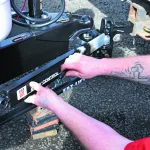
14. This Eaz-Lift hitch is equipped with an independent sway control, which is installed at this point. Depending on the hitch brand and design, the sway control may be separate or integrated into the hitch.
15. Attach the safety chains and breakway cable. Depending on the trailer and hitch, you may choose to cross the chains underneath the hitch to form an “X” that will cradle the coupler should it disconnect from the trailer. The breakaway cable automatically applies the trailer’s brakes in the event of a disconnection.
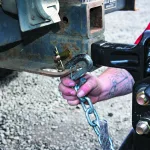
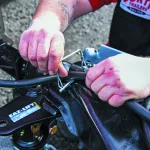
16. Pro tip: Feed the power cable from the trailer through the coupler lock clip to prevent the cable from dragging or making contact with the road surface. Plug the power cord into the receptacle.
17. Lower the trailer, and the job is complete. The trailer should now be almost perfectly level with the tow vehicle. IMPORTANT: When you want to disconnect, raise the tow vehicle and trailer using the A-frame jack until there is no longer any tension on the draw bar chains (wiggle the draw bar chains back and forth to be sure). Then, you may lower the saddles to release the chains.