

DEAR EDITOR
DISCOUNT FUEL CARD SAVINGS
On the recommendation of several other RVers, I began using a fleet diesel discount card. After 7,000 miles or so. I started to notice a pattern: The participating stations that accepted the fuel card always seemed to have the highest pump price in their area, and the discount seemed to yield a price that was in the same range as other stations. So, on my most recent fill-up, I noted the price at the competing truck stop right across the road.
Here’s the breakdown:
- Participating station advertised price was $5.549.
- Discount fuel card advertised price was $4.769.
- I pumped 63.441 gallons, for an “at-the-pump” cost of $352.03.
- Fuel card gets/keeps 10 percent of the discount, plus a 40-cent transaction fee, for a net cost to me of $307.35.
When not using the fleet fuel card, I use a Visa credit card with a 2.25 percent cash rebate on every purchase. Had I used that at the other station, it would have cost me $310.80 at the pump; after my rebate, the net cost to me would have been $303.80 — $3.55 less than the fleet card’s “discounted” cost. The fleet “discount” actually cost me 1 percent more than the open market price!
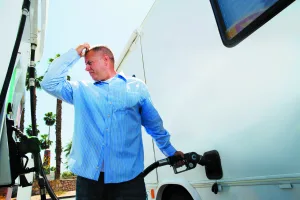
Filling the tank can be painful, prompting many RVers to look into the savings promised by discount fuel cards.
The true discount is not the difference between the pump price at “their” station; it’s the difference between the actual fuel card’s final cost and what you would actually pay at the competing station. I suspect few people consider that or take the time to do this level of net-cost comparison. Not a significant benefit, in my opinion.
— KERRY MILLER, F558754
Racine, Wisconsin
Editor’s note. Discount fuel cards and other programs help RVers to save money on diesel or gas as they travel. The fuel cards can be used at participating travel centers with commercial truck lanes, making it easier for owners of larger RVs to use larger fueling lanes and high-speed pumps. Typically, users pay at the pump, receive a discounted price, and are charged a transaction fee. As with loyalty cards in general, customers should investigate the pros and cons themselves and determine whether a discount fuel card is advantageous for their particular situation.
WE WANT TO HEAR FROM YOU!
Family RVing welcomes comments about articles published in the magazine or topics of interest to RV owners. Email readerswrite@frva.com; mail to Readers Write, Family RV Association, 8291 Clough Pike, Cincinnati, OH 45244. Please include your name, city, and state/province. Letters may be edited for space and clarity.