
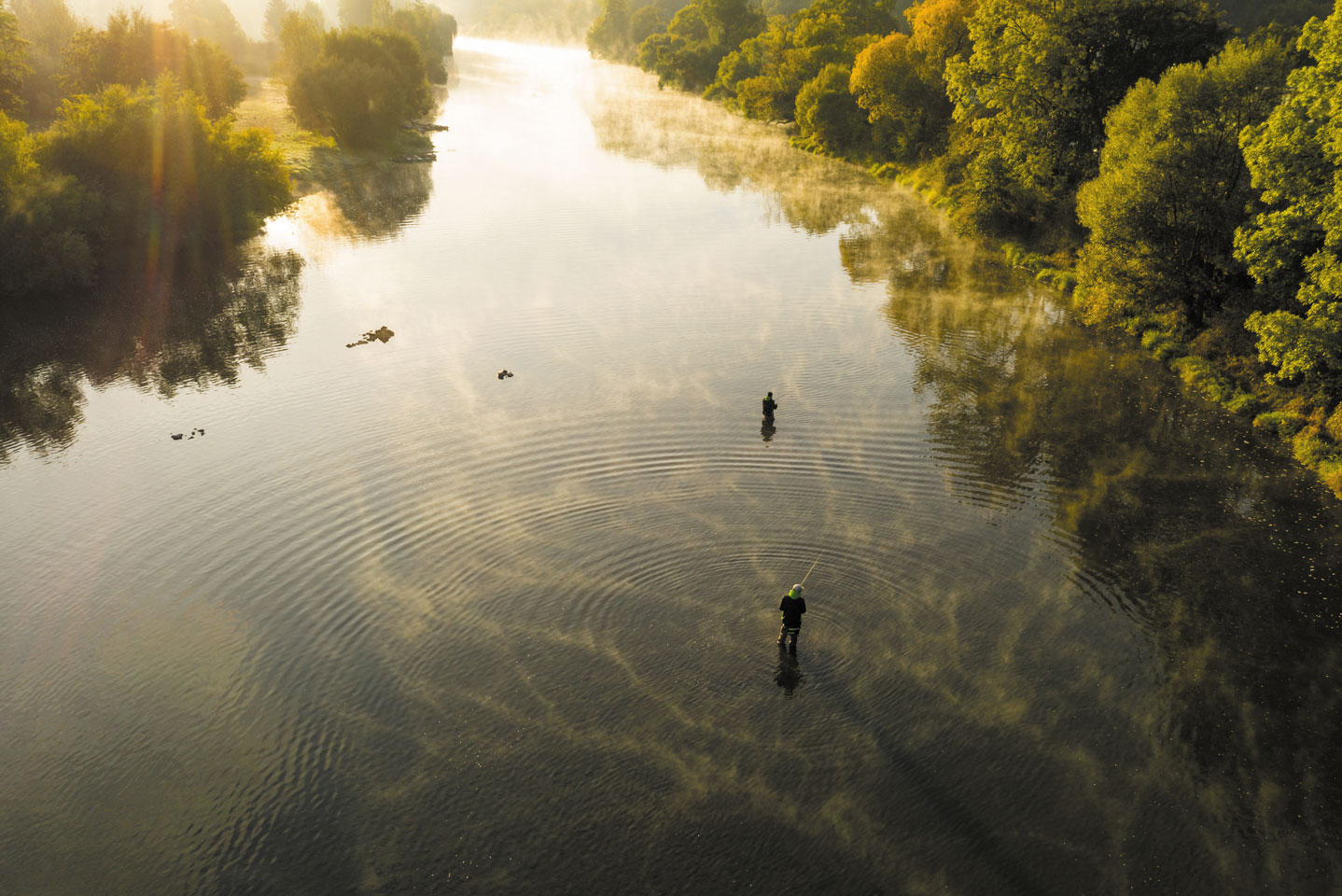
An introduction to a pastime whose allure goes well beyond catching fish.
By Bruce Murray, F361709
October 2019
In our family, there was no clear line between religion and fly fishing. We lived at the junction of great trout rivers in western Montana, and our father was a Presbyterian minister and a fly fisherman who tied his own flies and taught others. He told us about Christ’s disciples being fishermen, and we were left to assume, as my brother and I did, that all first-class fishermen on the Sea of Galilee were fly fishermen and that John, the favorite, was a dry fly fisherman. — Norman Maclean

The author and his wife, Deborah, during a Shenandoah Valley fishing trip.
The opening lines of the novel A River Runs Through It, the story of two brothers coming of age in early 20th-century Montana, alludes to the almost religious fervor that inspires and motivates ardent fly fishermen. My parents’ house was on a lake in the country, and some of my earliest memories are of fishing with my father and brother. My father was a fly fisherman, and as a boy, I did not understand or appreciate the passion he had for that type of fishing. I came to understand many years later — after I married, started a family, and took up the sport myself — what my father was trying to teach me: that fly-fishing has absolutely nothing to do with catching fish. Fly-fishing, particularly dry fly-fishing for trout, is a therapeutic exercise; it’s a bonus if you happen to catch a fish.
What Is Fly-Fishing?

1) With the line let out (shown here as the fly comes to the end of its drift), and the rod tip pointing roughly along the length of the line, lift the rod tip to the 10 o’clock position, lifting some line as well.
People fall in love with fly-fishing because of the beauty of the cast, the relaxation, and the fact that it usually takes place in a scenic location. Besides, it’s fun. Fly-fishing is very different from bait casting or spin fishing. In the latter two, you cast live bait or a lure, both of which have some weight to them, using a relatively thin line. In fly casting, you present an almost weightless artificial fly using the energy and speed imparted to a relatively thick and heavy line (as compared to a spinning or bait-casting line) by the action of the fly rod. Many people are put off by fly-fishing because they believe learning to cast is difficult: it is not. If you can clean a paintbrush, you already have mastered the fundamentals of fly casting.
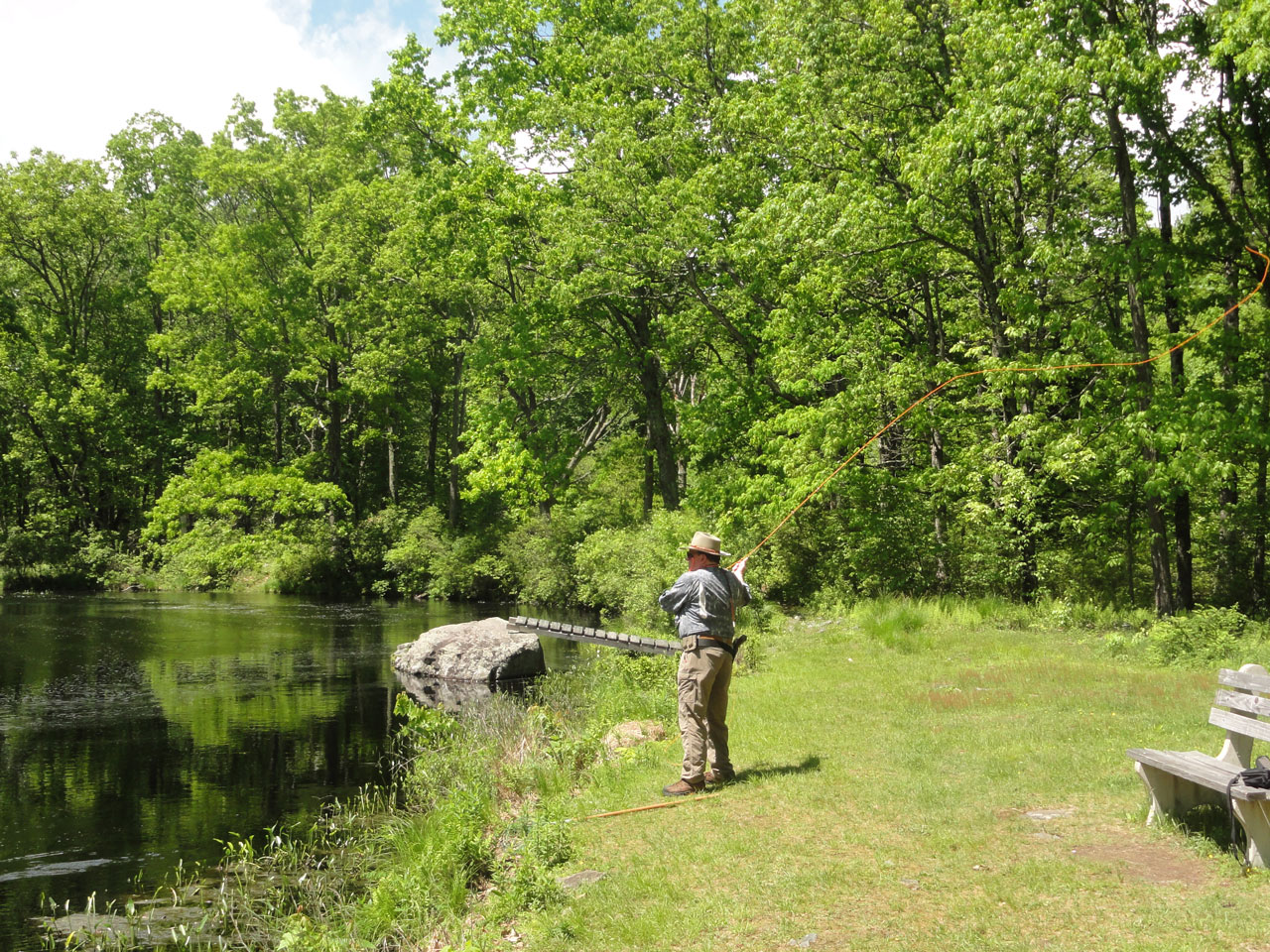
2) Using your forearm, snap the rod back to the 2 o’clock position, moving the rod tip in a straight plane. The line should loop behind you.
When you clean a paintbrush, you soak the bristles in solvent or water to thin the paint, and then you flick the brush with your wrist to expel the thinned paint from the bristles. When you flick the brush away from you, the bristles bend backward as the brush moves forward. When you abruptly stop the brush, the bristles bend forward, expelling the paint from them.
Think of a fly rod as a single bristle. Hold the rod firmly but not tightly in your hand with your thumb on top of the grip, pointing up toward the tip of the rod. Strip some line from the reel (pulling it through your fingers) and flick the rod tip from the 10 o’clock to the 2 o’clock position several times, paying out line and stripping line as needed, hesitating at each position, until you have 20 feet or so of line out before you.
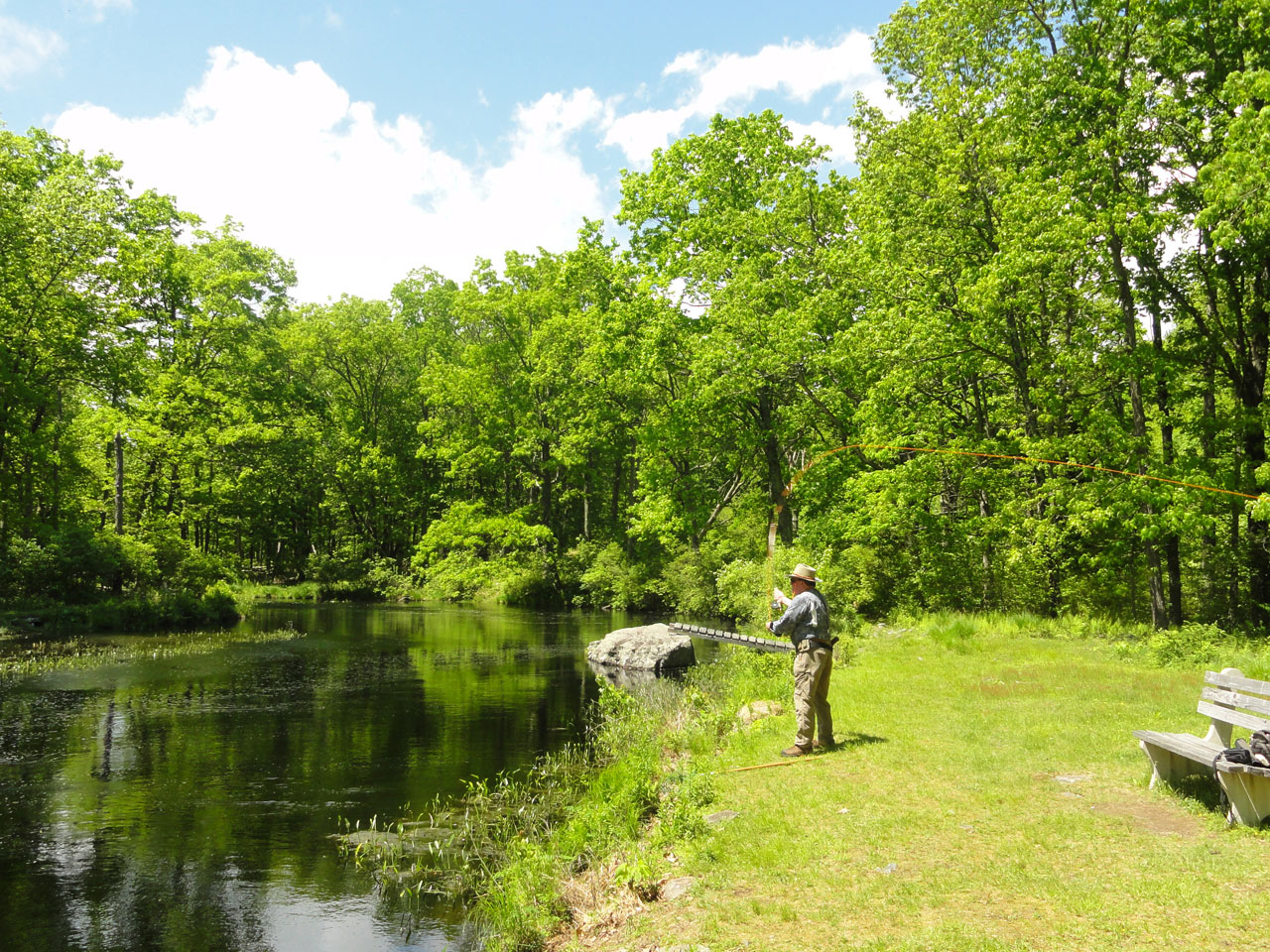
3) Hesitate at the 2 o’clock position until the line straightens out behind you (you’ll feel the line tug when it is straight). Once the line is straight, using your forearm, snap the rod forward, bending (loading) the rod.
With the line lying on the water, lift the rod tip to the 10 o’clock position. Then, using only your forearm, briskly snap the rod back over your shoulder to the 2 o’clock position, keeping the rod tip in a straight plane, and stop abruptly. The rod will bend, or load, looping the line behind you. Hesitate at the 2 o’clock position until the line straightens out behind you; with experience, you will feel the line tug at the rod when it straightens. Looking over your shoulder when learning is okay.
Once the line is straight, snap the rod forward, again using your forearm, to the 10 o’clock position, and stop abruptly. The rod will bend back as it snaps forward and then will bend forward, or unload, when it stops, rolling the line forward in a loop.
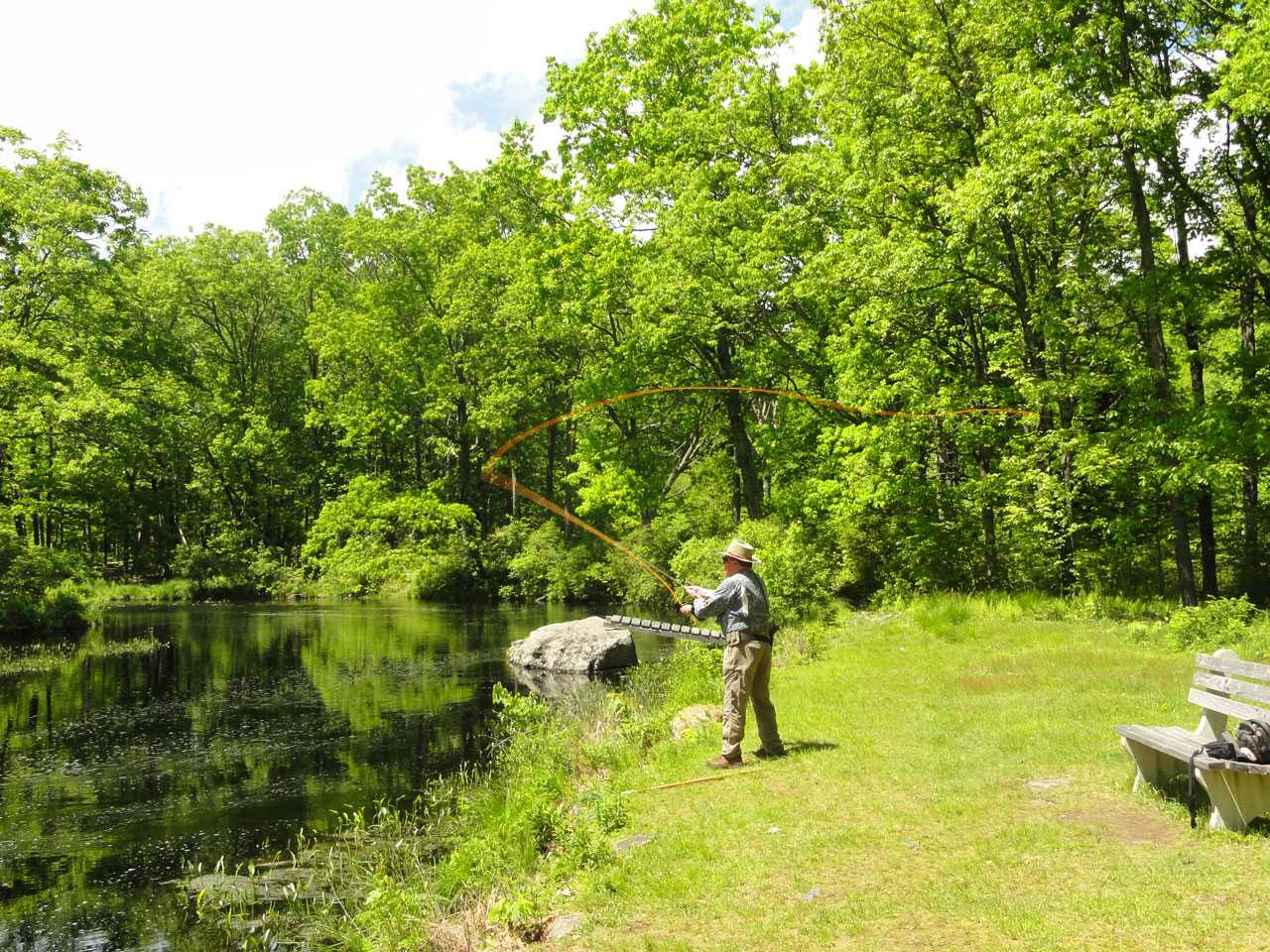
4) When the rod tip reaches the 10 o’clock position, stop abruptly. The rod will unload, propelling the line forward.
As the loop lengthens and the line starts to straighten, begin to follow it down: as the line fully straightens, follow it down to the water with your rod tip, letting it land gently on the water. The unrolling line should result in the leader (the line between the fly line and the fly) and the tippet (the end section of the leader) also unrolling and the fly landing gently on the water.
Equipment
Various sizes, or weights, and types of fly line exist. Sizes range from 1 weight (wt.) to 14 wt.; the larger the number, the heavier, or larger the diameter, the fly line is. The 1-5-wt. lines typically are used for trout; 6-8 wt. for bass and larger lake fish; 7-14 wt. for salmon and saltwater beasts.
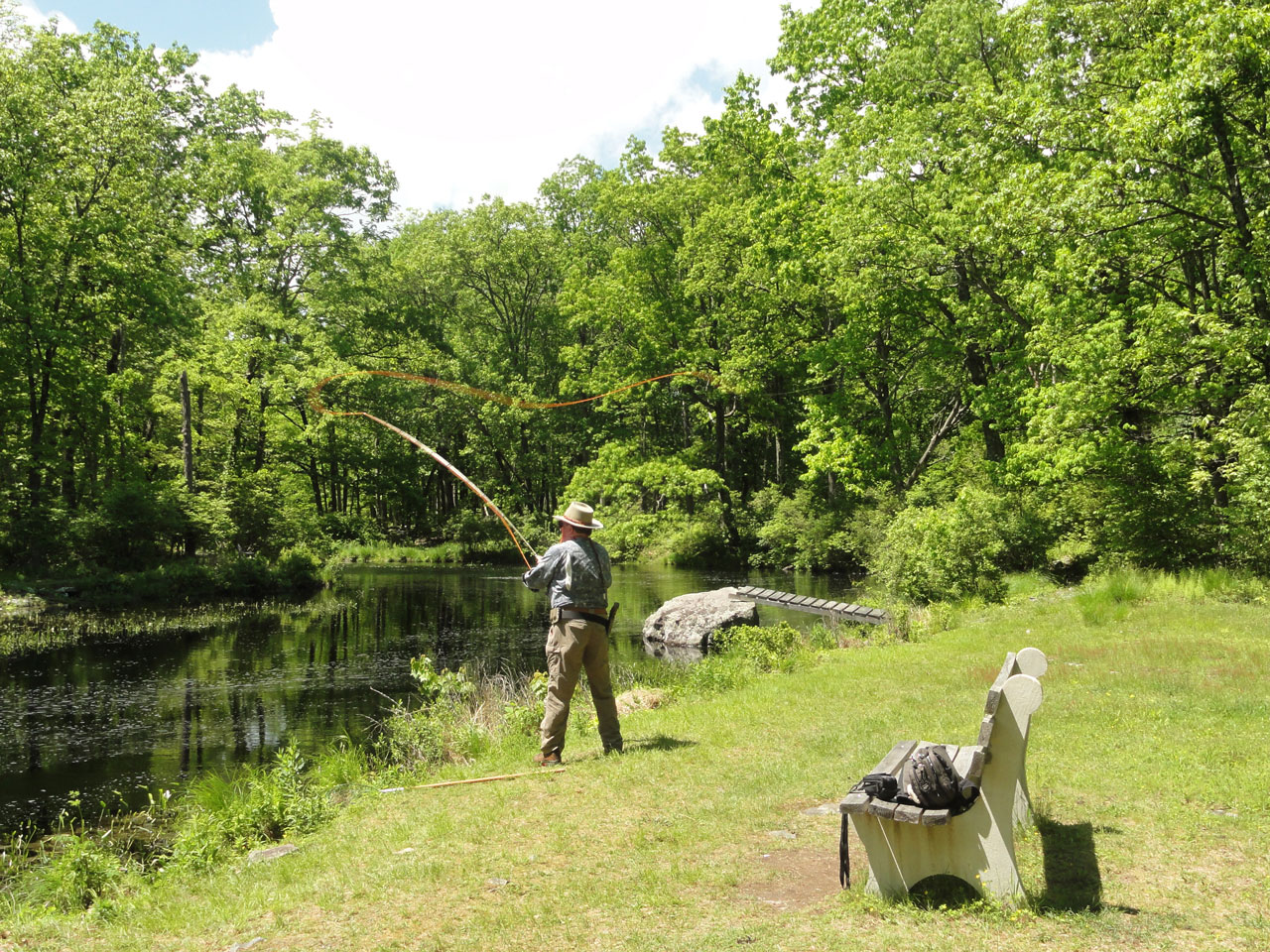
5) After snapping the line forward and stopping at the 10 o’clock position, the line should roll forward in a loop.
The basic line types include weight forward (WF) — the forward 15 feet of the line is thicker than the remainder of the line; double taper (DT) — the first and last 15 feet of the line are thinner than the center section of the line; and level (L) — the line is of uniform diameter throughout its length. Lines are classified as floating (F), sinking (S), or sink tip (F/S).
WF lines are easier to cast, particularly in windy conditions, while DT lines provide a more delicate presentation. When buying fly line, note that a code on the container indicates the type of line. Thus, WF-5-F would be a weight forward, 5 wt., floating line.
Fly rods are made to cast, or throw, a particular weight of fly line and have different “actions,” from fast (a stiffer rod that throws a tight loop) to slow (a more flexible rod that is easier to cast and delivers the fly more delicately). The matched line and rod create a balanced system.
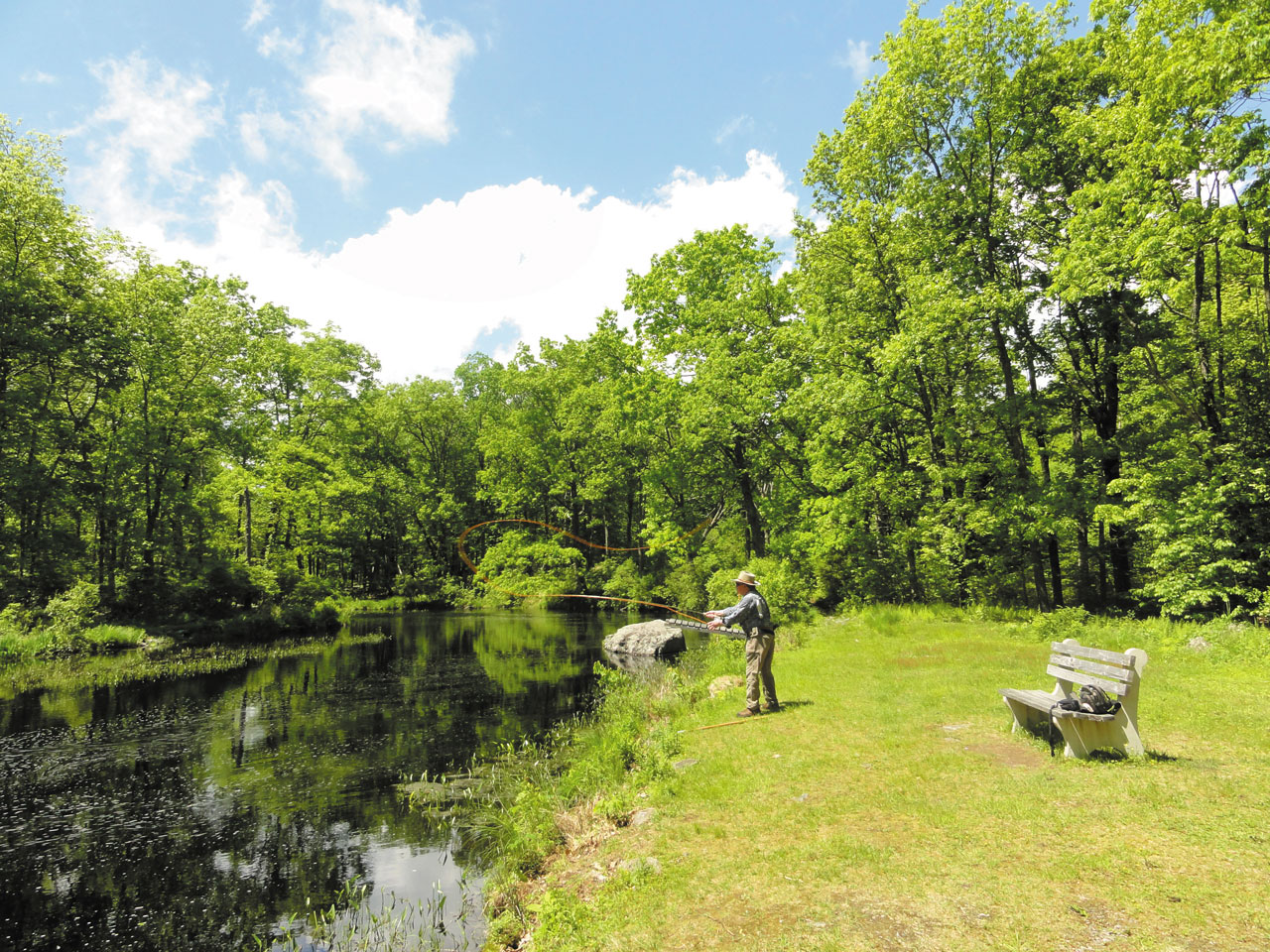
6) As the loop lengthens and the line begins to straighten, begin to follow the line down with the rod tip.
The system consists of the rod, reel, fly line, backing, leader, and tippet. Flies are tied to the tippet; the tippet to the leader; the leader to the fly line; the fly line to the backing; and the backing attaches to the reel. Fly lines normally come in 90-foot lengths, which is not adequate for playing large, powerful game fish, so up to 200 yards of braided line is attached to the reel as backing, and the fly line is tied to that.
For trout fishing, a fly reel is merely a receptacle to hold the fly line. Most trout anglers play the fish using their non-rod-bearing, or reel, hand to retrieve the line. Pinch the line between the rod grip and the fingers of your rod hand as you strip in the line, letting it fall on the water or ground, and then reel it back onto the reel spool after the fish has been landed. For saltwater fish or salmon, a sturdier reel with a good drag is required, and the fish is played from the reel. Whichever way you play a fish, it is important to keep your rod tip high. As the fish runs, the bending rod acts as a shock absorber, preventing the tippet from breaking.
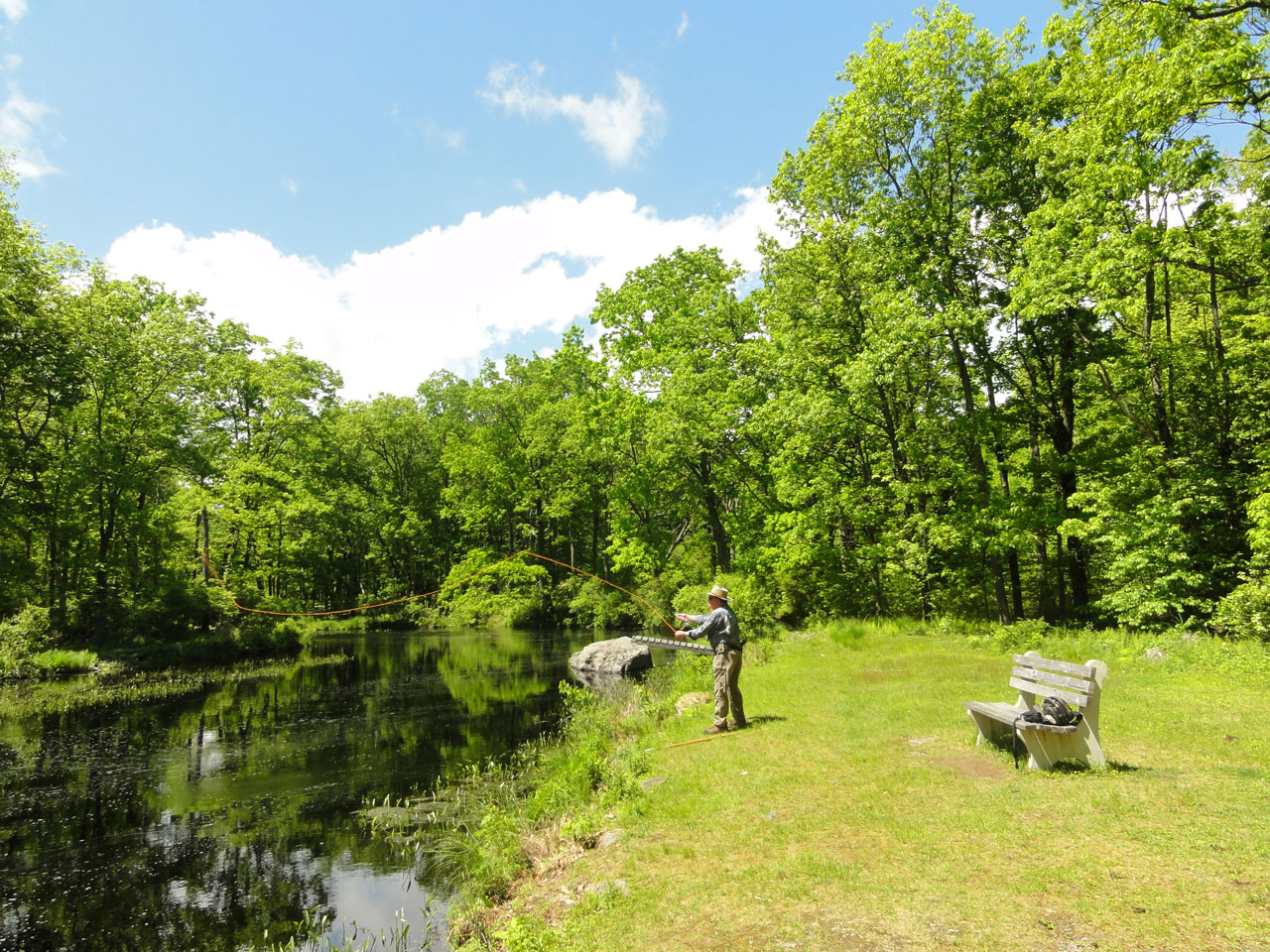
7) As the line fully straightens, follow it down to the water with the rod tip.
Ninety percent of a trout’s diet consists of bugs in all stages of their life cycle. Flies are tied to imitate these bugs. Three basic types of flies are used in trout fishing: dry flies, nymphs, and streamers.
As their name implies, dry flies float on the surface of the water. The fish must rise up to take the fly, and the angler can see when the fish strikes. To me, dry fly-fishing is the most rewarding. However, since 80 percent of the bugs a trout eats are taken underwater as opposed to on the surface, it also is the least productive type of fly-fishing. A dry fly fisherman’s challenge is to “match the hatch” — to select the dry fly that most resembles the bugs (in color, shape, and size) that are alighting on the surface of the water and that the trout are taking.

8) Let the line land gently on the water. As the line unrolls, the leader and tippet should unroll also, and the fly should land delicately on the water.
Nymphs imitate the bugs that live beneath the surface before they mature, burst forth, dry their wings, and fly off. Because nymphs sink, an angler cannot see them and cannot see the fish strike them unless the water is extremely clear. Some anglers use a strike indicator: a small piece of foam fastened on the leader that by its change of motion can help indicate when a fish strikes.
Streamers imitate minnows and other subsurface dwellers. They are more akin to the lures used in spin fishing.
Getting Started
While you can spend several thousand dollars on a custom bamboo fly rod, you can purchase a starter outfit from several sources for less than $100. A starter set includes a rod, reel, line, backing, leader, tippet, and a few flies. I have yet to find a trout that could differentiate between being hooked by a $3,000 custom bamboo rod or a $59 graphite rod.
If you want to try fly-fishing, I would recommend a 5- or 6-weight medium- to slow-action rod that is 8 to 8.5 feet in length, throwing weighted-forward, floating line. This rod/line combo is very versatile. Many anglers eschew colored lines. When trout look up at a line floating on the surface, the lines all look the same to them: like a thin, black line, regardless of color. I started out with orange fly line that instructors use in demonstrations, because I could see it and more easily determine what I was doing wrong in order to correct my casting mistakes. I still use the orange line and have caught many, many trout.
In addition to a rod, reel, and flies, you’ll want to purchase a few other things to get started. They include a pair of nippers, similar to nail clippers, to cut tippet and line tag ends when you are tying on flies; a fly vest or chest pack to carry all your equipment; a fly box to contain your flies; a spool of tippet material (as you tie on flies, your leader will become shorter, so you’ll need to add tippet to maintain length); forceps to remove the hook from the fish’s mouth; a landing net; waders/boots or boots (if you purchase waders and boots, opt for rubber-soled boots, as felt soles can carry bacteria from stream to stream).
You’ll also want to master a few rudimentary knots to tie on flies and mate the backing, line leader, and tippet. Oh, yes, if you are visually challenged, a pair of magnifiers that clip to the bill of a ball cap and fold up and down will save a lot of frustration when trying to tie on a fly.
Starter outfits can be found online or at any of the big-box sporting goods stores, such as Cabela’s, Bass Pro Shops, L.L. Bean, or Orvis. The Orvis store near us offers free lessons, and they supply the equipment.
Conclusion
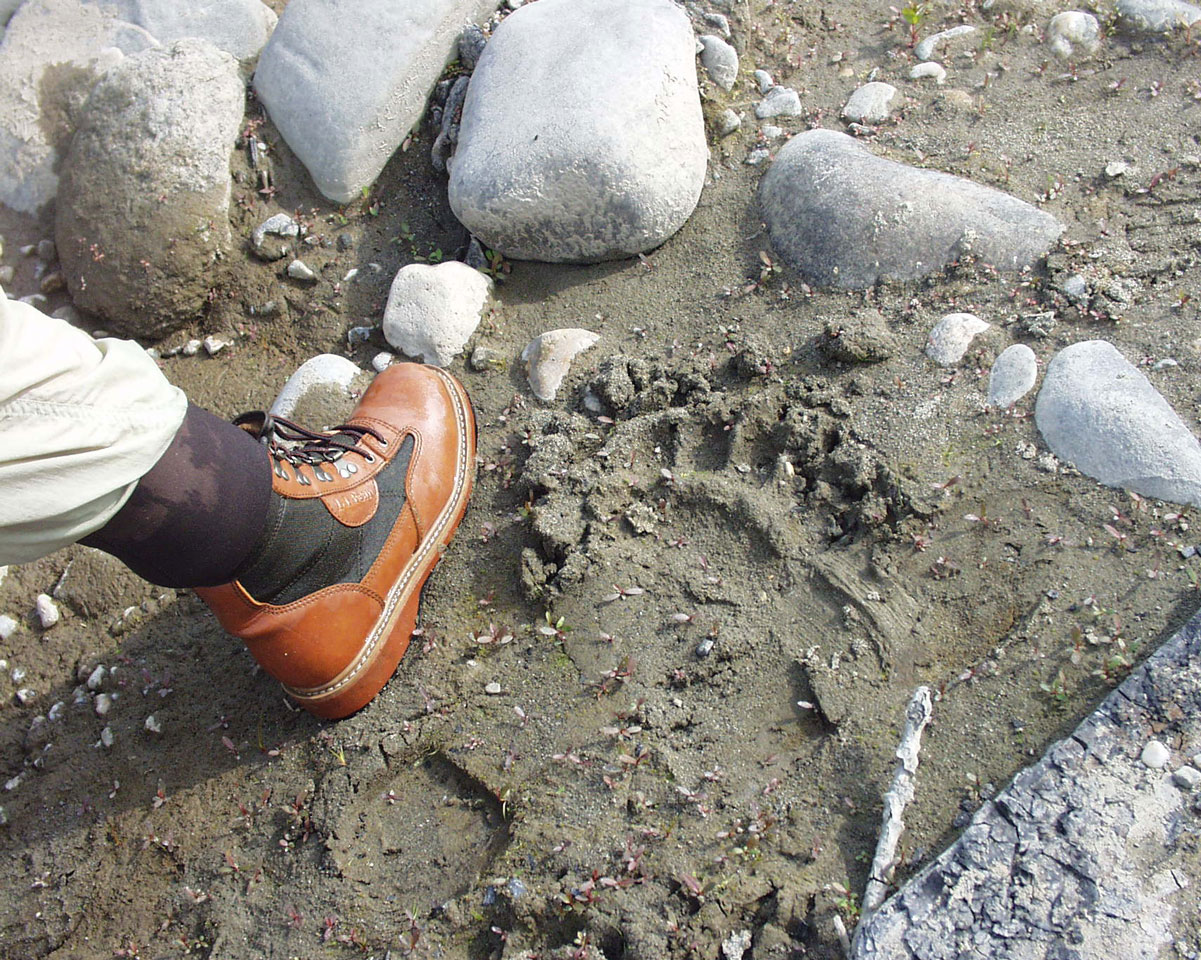
Deborah places her foot next to a grizzly bear track on the banks of an Alaska salmon stream.
I have now been fly-fishing for more than 40 years. My father left me my great-great grandfather’s bamboo fly rod that was made in Scotland, and which now hangs in a place of honor over a fireplace in our home. Our RV has permitted my wife, Deborah, and me to experience many fly-fishing expeditions, from Florida to Alaska (where bears were an issue). But the most gratifying fishing I have ever done is dry fly-fishing small streams in northern Maine and Montana with a little 7-foot 2-weight rod for native brook trout.
Further Info
To learn more about fly-fishing, including the necessary equipment, check out the following websites:
www.cabelas.com
Includes written and pictorial instructions.
www.orvis.com
Features a series of instructional videos.
www.llbean.com
Offers hands-on “Outdoor Discovery” courses.
Good reference books include The Orvis Fly-Fishing Guide; Fly Fishing for Dummies; and L.L. Bean Ultimate Book of Fly Fishing. The L.L. Bean book gets into fly tying and is a bit more technical than the other two.