
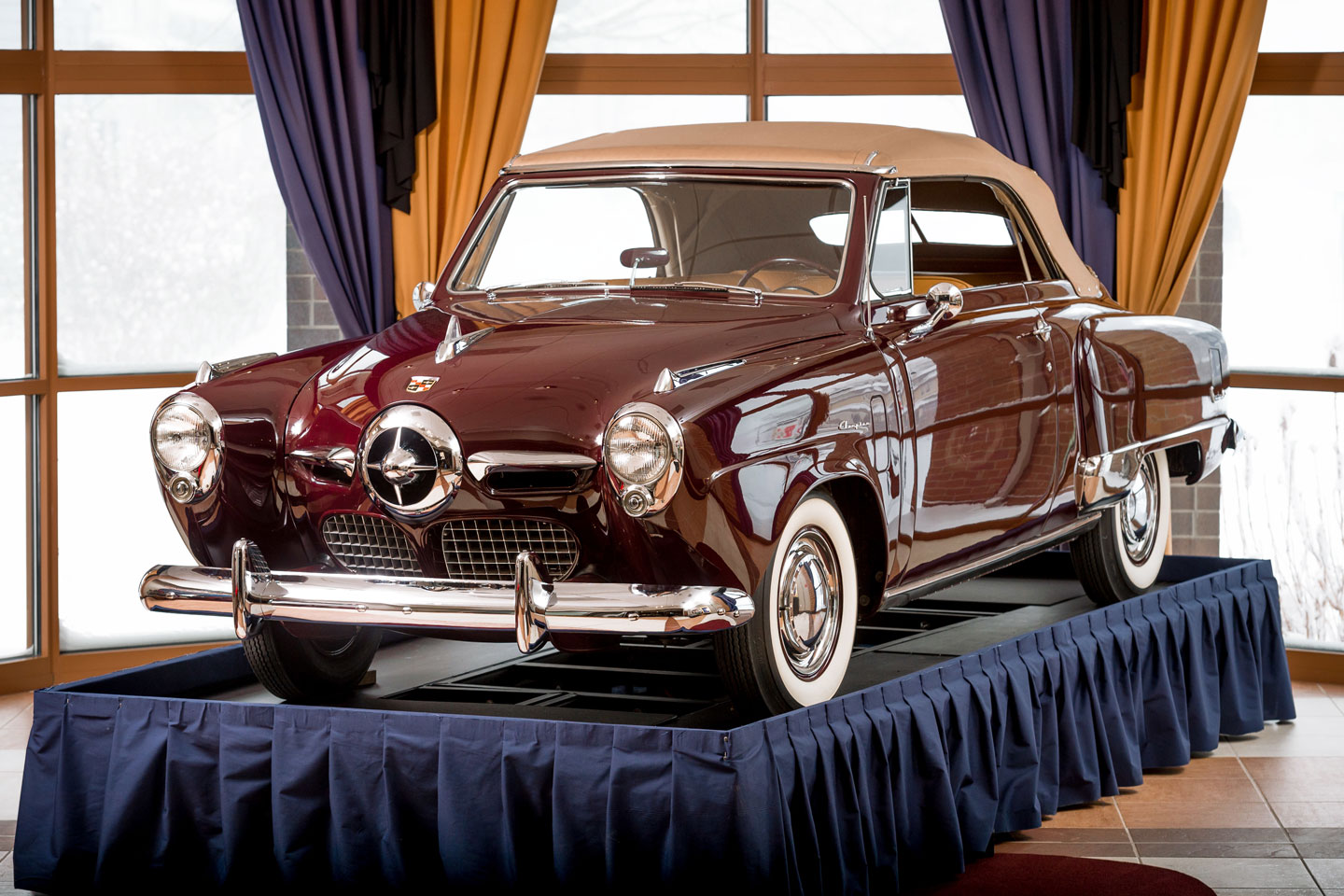
Lovers of automobiles and automobile history will discover myriad treasures at the Studebaker National Museum.
By Richard Bauman
December 2020
For much of the 20th century, most American cars were built in Detroit, Michigan. General Motors, Ford, and Chrysler dominated the automotive scene, but another major car company, Studebaker, shunned Detroit. It was headquartered in South Bend, Indiana, until the late 1960s and built autos in the Motor City for just two decades.
While the Studebaker Corporation has been gone for more than 50 years, its memory lives on at the Studebaker National Museum in South Bend.
Of course, the museum focuses on the company’s history, from its beginning in the mid-1800s until its ultimate demise a little more than 100 years later. But it goes beyond Studebaker. It presents a microcosm of the history of all auto companies and cars built in the United States throughout the 20th century — some magnificent creations and other nightmarish concepts, some mechanically impressive vehicles and others a notch below run-of-the-mill.
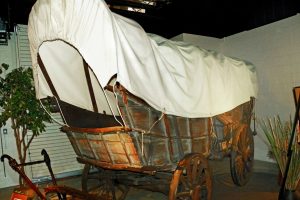
Family patriarch John C. Studebaker built a Conestoga wagon in 1835.
Where It Began
The museum’s main level introduces you to the company’s history, which is intertwined with that of the Studebaker family. John C. Studebaker, family patriarch, built his first Conestoga-style wagon around 1835 to move his family from Gettysburg, Pennsylvania, to Ashland, Ohio.
About 16 years later, the Studebaker clan relocated to South Bend. John C.’s two oldest sons, Clement and Henry, established H & C Studebaker Company, a blacksmith shop and wagon-building enterprise. The first vehicle bearing the Studebaker name was a farm wagon they sold for $175.
John M. Studebaker, who was two years younger than Clement, heard the siren call of the California goldfields and the tales of easy riches. He arrived there in 1853 with 50 cents in one pocket and a lot of ambition in the others. He didn’t dig for gold, however. Instead he saw that miners needed a way to move rocks and ore, and he filled that need by building wheelbarrows. The miners jokingly called him “Wheelbarrow Johnny,” but they gladly paid top dollar for his sturdily built, single-wheeled carts that overcame the harsh conditions of gold mining. A replica is displayed in the museum.
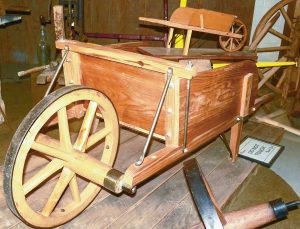
John M. Studebaker made wheelbarrows for California miners in the 1850s.
In just five years, John M. socked away about $8,000. Then he took his money and ran — back to South Bend, where he bought brother Henry’s share of the business.
As the American Civil War loomed, the Studebaker brothers began making wagons for the Union Army, and they continued supplying them throughout the war. The company’s ability to deliver reliable wagons for the war effort enhanced its reputation and brought it military business afterward, including World War II.
Studebaker Automobiles
The first Studebaker automobiles appeared in 1902 and were electric-powered. A small and sleek 1907 Studebaker Electric Runabout is prominently displayed in the museum.
They weren’t highly successful, however. Reliability, battery life, and limited range doomed them. In 1904 Studebaker began producing gasoline-powered vehicles to meet the market demand for longer-range, more powerful cars. By 1912 the factory was pumping out gasoline-powered cars only after acquiring a Detroit company and forming The Studebaker Corporation.
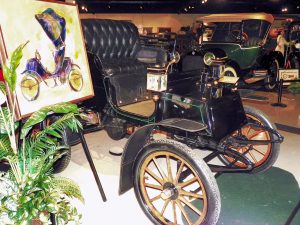
The electric-powered Studebaker Runabout was the company’s first automobile; shown here is a 1907 model.
For those of us mostly familiar with later-model, often uninspiring Studebaker designs, the cars it produced in the 1920s and 1930s were surprisingly beautiful. In terms of styling, engineering, and quality of manufacturing, these cars competed on equal footing with top-of-the-line models from other manufacturers. Examples of Studebaker autos from the ’20s and early ’30s abound in the museum.
As you check out the historic cars and review the Studebaker models of the late 1930s and early 1940s, it’s obvious the company’s cars were similar in design to others of the time. The 1940 coupe, for example, has a strong resemblance to the 1940 Ford coupe, and it isn’t far removed from that year’s Chevy coupe. In the late 1940s, however, things changed.
Studebaker stepped away from the look-alike character of most prewar and postwar American cars. It started with the 1947 models, which had elongated trunks and large, wraparound rear windows; they were eye-catching, attention-getting, and a far cry from the “brick with wheels” models from other car companies. That design evolved into its “bullet-nose” design of the 1950 iteration of Studebaker autos.
Car buyers were intrigued by Studebakers equipped with V-8 engines and automatic transmissions. The company reached its peak for car sales with its 1950-52 models.
Perhaps Studebaker’s most innovative and desirable model ever was the 1953 “Loewy Coupe,” a low-slung beauty from the Raymond Loewy design group. It was, without question, ahead on the design curve.
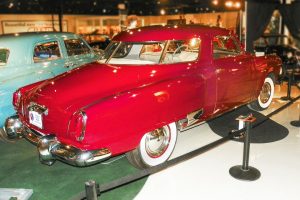
The 1950 Studebaker Commander Starlight Coupe featured an elongated trunk and a wraparound rear window.
The Starliner and Starlight coupes (the official company names) were just 56 inches high, and certainly the lowest-profile production car built in the U.S. at the time. Other American models were at least 8 to 10 inches higher. The “European look” coupes were offered in six versions, depending on trim and minor body variations.
The Loewy Coupe won numerous design awards, including the 1953 Fashion Academy Award. The Museum of Modern Art called it a milestone in automotive design. The Starliner received Motor Trend magazine’s award for the “most aesthetically styled” car of the year. Some industrial designers declared it the outstanding American car of the 1950s.
The company’s ads for the Starliner proclaimed it to be “The new American car with the European look.”
Studebaker had hit a home run with this design. But when it came to producing the coupes, the company struck out. The car was an overwhelming hit with auto enthusiasts and consumers, to the surprise of Studebaker’s management and marketing department. Car buyers pretty much shunned the company’s roomier sedans, opting instead for the sexy, low-slung coupes.
The company hadn’t anticipated the overwhelming acceptance of the Starliner. Regardless of car brand, coupes usually were less popular than sedans and generally accounted for just 15 percent to 20 percent of sales. Studebaker followed this ratio in tooling up for manufacturing its 1953 cars, and thus couldn’t keep up with demand for the coupe. Frustrated buyers not only turned away from the available sedans, but from the company, too.
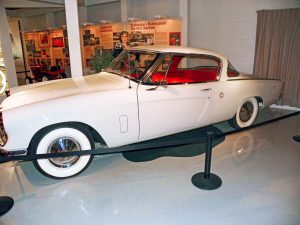
A 1953 Studebaker Champion Starliner Hardtop.
From 1953 until its U.S. demise in 1963, and 1966 in Canada, the company was profitable just one more year.
One of the more unusual cars in the museum isn’t even a Studebaker. The 1934 Bendix was a showcase for Bendix automotive products. The company made automobile starters and brake systems, among other items. Hand-built by Bendix employees, with a streamlined grille and a rounded front end, it resembles Chrysler Airflow cars of the same era.
The adage “Two wrongs don’t make a right” was never truer than in 1954 when the Packard Motor Car Company bought Studebaker and formed the Studebaker-Packard Corporation. Both companies were financially troubled with sagging sales. It was hoped that by coming together, they could become efficient, profitable, and remain afloat, but the company never turned a profit.
The Packard Predictor was the company’s last futuristic concept car. Built for the 1956 Chicago Auto Show, its special features included a wraparound windshield, sliding roof panels, and swivel seats for easy entry. It had a retractable rear window that gave the car ventilation like that of a convertible. The car sported a fiberglass body, retractable headlights, and a vertical grille.
In April 1962, Studebaker-Packard introduced the Avanti, which it described as “America’s only four-passenger high-performance personal car.” In April 1962, Studebaker-Packard introduced the Avanti, which it described as “America’s only four-passenger high-performance personal car.” Company president Sherwood Egbert developed the idea for the car and turned it over to Raymond Loewy and his designers. The Avanti had a fiberglass body and was powered by a significantly modified high-performance version of the Hawk engine. It was the first American-built car with disc brakes.
Egbert planned to produce 20,000 Avantis in 1962, but less than 5,000 were made. When the South Bend plant closed in December 1963, the Competition Press reported that just five were in stock.
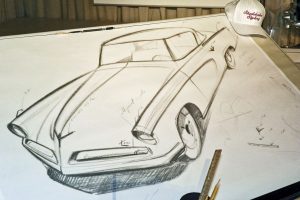
An early design sketch.
Studebaker And The Military
On the museum’s lower level is an area dedicated to the little-known history of Studebaker military vehicles. During the Spanish-American War, and even World War I, the company supplied horse-drawn ambulances and other conveyances to the military. Before, during, and after World War II, Studebaker developed powered vehicles for the armed services. They included large Studebaker 2½-ton 6×6 trucks and the M29 Weasel, an all-terrain vehicle that could carry personnel or cargo and reach 35 mph. The company also built B-17 bomber engines.
Presidential Carriage Collection
Of the museum’s numerous exhibits, perhaps the most historic is the Presidential Carriage Collection. Carriages used by presidents Lincoln, Grant, Benjamin Harrison, and McKinley are on display. Each presidential carriage is unique, but only two were built by Studebaker: Harrison’s and McKinley’s. Lincoln’s and Grant’s carriages were made elsewhere and later acquired by Studebaker.
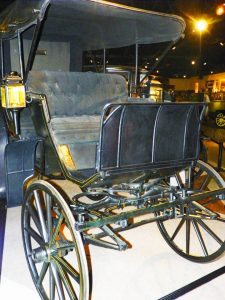
The Presidential Carriage Collection includes this Phaeton used by President William McKinley at his summer home in Canton, Ohio.
Without question, the carriage that garners the most attention is Lincoln’s. It carried the president and Mrs. Lincoln to Ford’s Theatre on the evening of April 14, 1865 — the night John Wilkes Booth assassinated Lincoln.
Driving Through History
If you are an automobile history fan, or you especially admire some of the Studebaker products, or you just want to experience a capsule description of the evolution of personal transportation from wagons to powerful vehicles, this is a place to do it.
Few companies have had a manufacturing lineage akin to Studebaker that dates from before the Civil War to the 1960s. Though now defunct, Studebaker Corporation was at times innovative and ahead of the automotive design curve, and at times it blundered badly. Nonetheless, it contributed mightily to American automotive history. At the Studebaker National Museum, you can view its products, good and bad, and learn about all of them.
Further Info
The Studebaker National Museum
201 Chapin St.
South Bend, IN 46601
(574) 235-9714
(888) 391-5600
studebaker.org
Handicap access is excellent. The museum is open Monday through Saturday from 10:00 a.m. to 5:00 p.m. and Sunday from noon to 5:00 p.m. It’s closed on most major holidays. At press time, the museum was open; view the facility’s updated COVID-19 policies on the website. To verify hours of operation, or to learn about special exhibits, programs, and current admission prices, call ahead.