
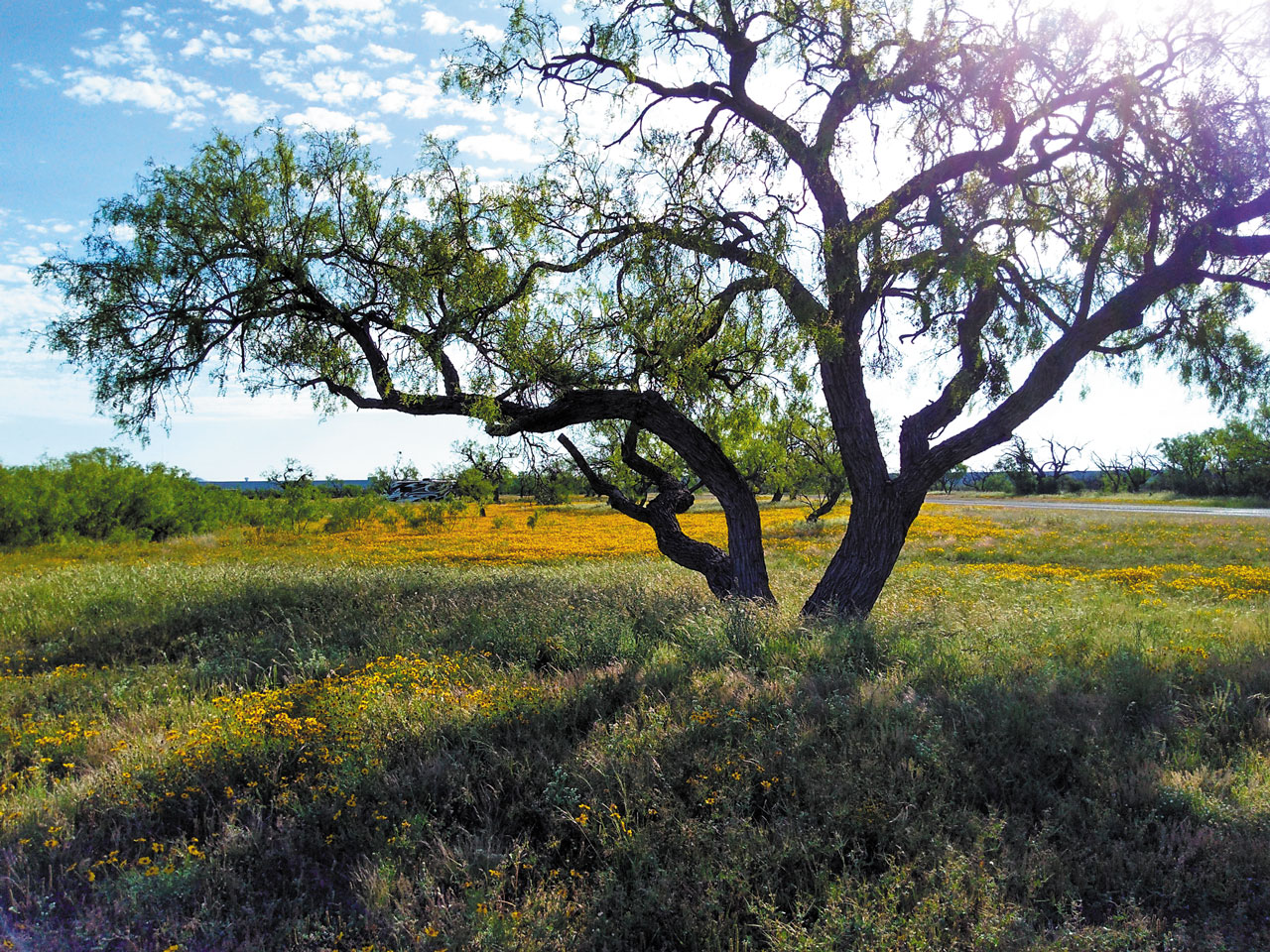
History and nature converge in San Angelo, which is home to a wonderful state park and imbued with many other charms.
By Ann Bush
March 2021
The last things I expected to find in the heart of west Texas, on arid, sandy plains where lizards, roadrunners, and snakes thrive, were a mermaid, pearls, and water lilies. But then again, it was my first trip to the city of San Angelo, an oasis in the middle of a sage-filled prairie. Anchoring three lakes and the beautiful Concho River, San Angelo hosts many best-kept secrets in Texas, including San Angelo State Park.
For more than 18,000 years, American Indians lived along the Concho River at the very spot where the state park now resides. Water from the river ran through the desert, serving as a survival marvel and providing the perfect place for wildlife to roam and humans to raise a family. Spaniards explored the area during the 14th century, creating maps and building roads that became popular routes for trading between the Indians and the Spanish and French traders.
In the early 1600s, the Spaniards established missions for the Jumano Indians. Spanish ranchers are the original “cowboys,” introducing horses and longhorn herds to Texas. Fences did not exist on these plains that seem to reach for the end of the Earth, hence the constant need for canvassing the land to guard their herds. Today, eighth-generation Spanish ranchers proudly continue to work the land in west Texas.
In the mid-1800s, Germans began to purchase land in the area. In 1867, Fort Concho was established to protect area settlers and travelers headed west. The large river allowed for irrigation, which attracted hopeful farmers and sheepherders. Today, the area is known for producing award-winning sheep and goats, celebrated by merrily painted life-size sheep statues that artfully guard street corners throughout the city of San Angelo.
San Angelo State Park
Bordering the O.C. Fisher Reservoir, the park protects the perfect habitat for a wide diversity of rangeland wildlife, including 50 species of mammals and at least 250 species of birds. The patient explorer often spies the shy roadrunner and the armadillo, the latter of which is the Texas state mammal. Occasionally, visitors spot a rare javelina. What you may never see is the endangered horned lizard, but the park takes pride in protecting the few that survive in a secret place on park grounds. The park is the home for part of the Official Texas State Longhorn Herd, which can be seen mingling happily with bison.
Spacious campsites range from primitive spots reached only on foot to more than 70 tent or RV sites equipped with water and electricity, including 50 sites with 30/50-amp electricity. One campground offers pens for horses. Dotted with Texas mesquite trees, the state park is level in most places, with shade shelters. Almost all campsites have remarkable vistas of sleepy sunsets sinking into the lake. A group pavilion plus two large group camping areas facilitate family or other gatherings.
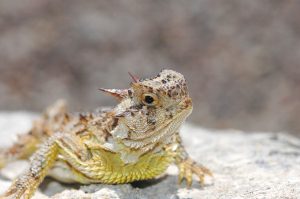
The rarely seen and endangered Texas horned lizard calls San Angelo State Park home.
Fifty miles of multiuse hiking and horseback riding trails, plus popular corkscrew mountain bicycle trails, are scattered throughout the 7,600-acre park, known for vibrant wildflowers throughout the summer. Unexpected features of the park include petroglyphs and prehistoric animal tracks dating back 250 million years to the Permian Period and found along the two-mile Dinosaur Trail. In addition to evidence of American Indian presence, archaeologists found a mastodon fossil site. Nearly six miles of scenic views on trails hugging the Concho River shoreline offer a whole new west Texas experience.
Kid-friendly activities include swimming, geocache games, and a treasure hunt that includes finding a mysterious 1847 gravesite.
Stocked with catfish as well as largemouth and white bass by the Texas Parks and Wildlife Department, O.C. Fisher Lake is a beacon for fishing boats. Paved boat ramps in different recreation areas make this lake very popular all year long; however, water levels vary throughout the year. Fishing also is allowed in the Concho River. No fishing license is required within the state park if one is fishing from a pier or the shore, and park headquarters staff loan equipment to visitors.
But where are the mermaids, you ask?
Pearls And A Mermaid
San Angelo State Park borders the city of San Angelo, where the Concho River winds through town along the nicely developed Concho River Walk. The Concho River means “River of Shells” in Spanish, and it is aptly named, with at least 12 varieties of fresh-water mussels/clams inhabiting the Concho River system. The mussels range from tiny tissue-shelled beings to larger, black-shelled producers of pearls called “Concho pearls.” American Indians in the area consumed the mussels and threw away the pearls. It was the Spaniards who found value in these uniquely shaped jewels.
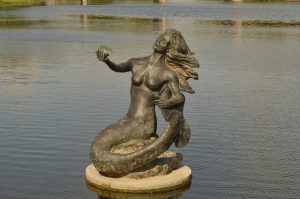
A bronze mermaid statue can be seen along the Concho River Walk in downtown San Angelo.
Concho pearls vary in size and range in color from light pink to dark purple, and from spherical to baroque in shape. Flat on one side, the pearls resemble a scoop of half-melted ice cream. The lakes and rivers around San Angelo are the only place in the world where these fresh-water pearls are found. To honor this history, a bronze mermaid statue holding a mussel graces the Concho River along the River Walk in the historic downtown district. These precious and unique pearls are sold in jewelry stores nearby. Legend holds that Concho pearls are found in the Spanish crown jewel collection.
Water Lilies
The city of San Angelo wasn’t done revealing its secrets. The friendly staff at the chamber of commerce office directed me to the most extensive collection of water lilies in the United States. To honor an interesting tale from the history of the Concho River, the city built the International Waterlily Collection ponds, located in Civic League Park, not far from downtown.
In the 17th century, American Indians told stories of hunting in a place of water with flowers. A few years later, a Franciscan monk discovered a stream diverted from the larger river. The stream formed a small natural pond filled with water lilies. He named it El Rio Florido — The Flowered River. After dams were built to create the lakes in the 19th century, U.S. Army cartographers renamed the waterway the Concho River. The secret stream and lilies disappeared, as do the lilies from the International Waterlily Collection ponds in the winter, when they are clandestinely stored in temperature-controlled buildings.
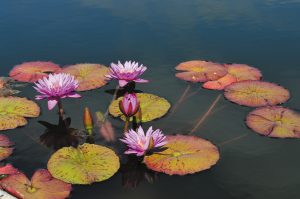
Beautiful specimens in the International Waterlily Collection ponds.
Fort Concho
If you are a military enthusiast, visit Fort Concho, an Army post awarded National Historic Landmark status, because of its historical significance to the famous and brave “Buffalo Soldiers.” Elements of all four of these cavalry regiments were stationed at Fort Concho. Buffalo Soldiers was a nickname of honor American Indian warriors gave to the African American soldiers, because of the soldiers’ fierce fighting ability and their dark curly hair, which to the Indians resembled the fur between a buffalo’s horns.
Hidden History
While shopping in the historic district in search of pearls, I went underground for an interesting view of the city. A few years ago, an underground tunnel system was discovered and now is being explored. Stories had circulated during the pioneer days about men who dropped off their wives for shopping and claimed they were going to the bank; instead, they went underground undetected to reach the saloons. During Prohibition, the tunnels were used to store illegal booze and to operate speakeasies. When liquor once again became legal, the tunnels were boarded up for safety reasons and forgotten. A small section of one tunnel is being renovated into the Underground History Museum, located at the Jessie Rose Mercantile, which was once the John Fitzpatrick Saloon, established in 1884. Tours of the underground tunnel are available, but caution: A ghost reportedly haunts the stairway.
Across the street from the Jessie Rose Mercantile stands a beautiful building constructed by a young couple in the late 1800s. After they divorced, Mrs. Hatton, nicknamed Hattie, arranged to live upstairs, and Mr. Hatton ran a business downstairs. One day, Mr. Hatton disappeared and was reported to have left town. In order to keep her home, Mrs. Hatton turned to one of the few career paths available to women at that time -— prostitution. Miss Hattie became a very successful businesswoman, operating a profitable “gentleman’s club” for more than 30 years until it was closed in 1952 by the Texas Rangers. New owners renovated and reopened the home as Miss Hattie’s Bordello Museum. A vintage lounge and five bedrooms are dedicated to uncovering the story of this covert profession, even listing pay scales. Next door is the beautiful, restored Miss Hattie’s Restaurant and Cathouse Lounge, where I had a tasty lunch. Locals say they are famous for their steaks.
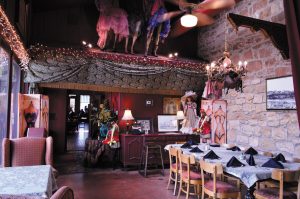
Miss Hattie’s Restaurant and Cathouse Lounge in downtown San Angelo makes a fun lunch or dinner stop.
On my last day in town, I couldn’t resist experiencing the water surrounding this oasis one more time, so I took a ride on a vintage steamboat, The Tule Princess. This small, authentic side-wheel paddle steamboat, reproduced to the most minute detail, takes visitors on Lake Nasworthy, located south of town near the San Angelo airport. The guided excursion slowly winds along a peninsula full of tule reeds and birds. Children under the age of 8 are charged only a dollar and sometimes get to steer the boat with the cheerful captain.
Coffee, Bread, And Wine
Following the Concho River south about 20 miles from San Angelo, one finds the little town of Christoval, home of the first art colony in Texas. It attracts hundreds of artists who paint along the Concho River during events planned by the San Angelo Art Club.
Head for downtown and make your first stop the quaint Concho Coffee House on Main Street for a creamy latté and delicious blueberry scones. Tell the owner, my cousin Kelly, that you read about Christoval in Family RVing magazine and make her smile. She will direct you to the Hummer House just a few miles farther south for a romp with hundreds of hummingbirds. For a tip (donated to charity), she will tell you about the nearby mysterious Mount Carmel Hermitage, where monks bake and sell bread and jams. With reservations and a donation, the monks give tours.
But don’t go home yet. On the way back to San Angelo State Park, stop at Christoval Vineyards and Winery and enjoy award-winning wine on a pleasant porch next to a field of grape vines. What a fabulous way to end a visit to this west Texas oasis, a land of pearls, a mermaid, water lilies, and more.
If You Go
More information about San Angelo State Park (362 S. FM 2288, San Angelo, TX 76901; 325-949-4757) can be found at www.tpwd.texas.gov/sanangelo.
The San Angelo Chamber of Commerce manages a well-designed visitors center on the Concho River (418 W. Avenue B), with staff ready to help folks Monday through Friday. They can also be reached at (325) 655-4136, or review their website at www.sanangelo.org.
Information about Christoval can be found at www.christovaltx.com.