
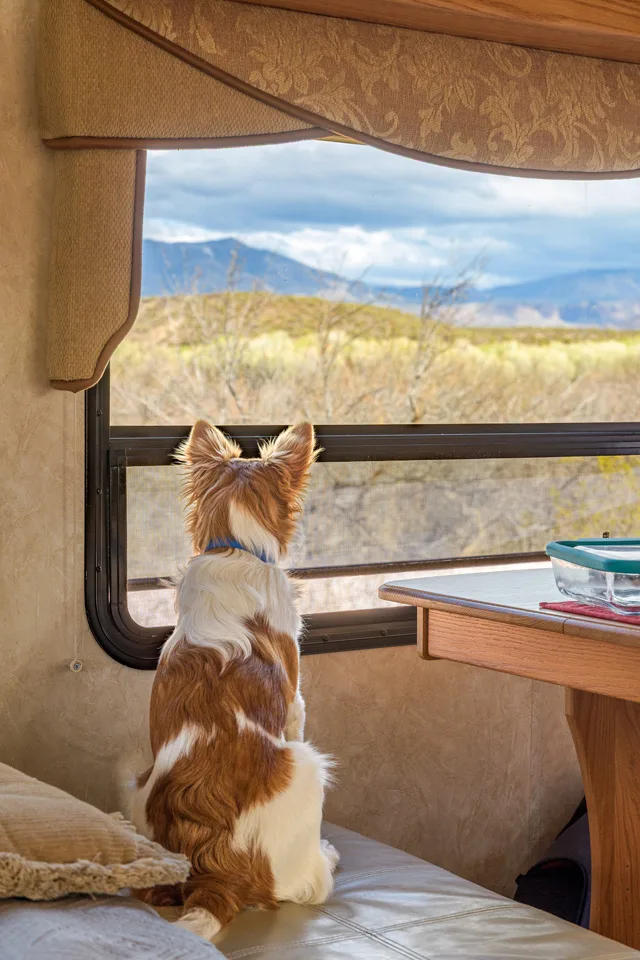
If you’re thinking of taking your canine companion on an RV trip, consider these pros, cons, and tips on what to expect.
By Emily Fagan, F547779
November-December 2025
We met our beloved dog, Buddy, at a shelter when he was 12 weeks old. We took him out for a trial weekend in our 36-foot fifth wheel. As he snuggled into our laps and hearts on our first night together, we realized we were now a family of three. The fifth wheel became his first real home.
We’d been traveling full-time as a couple for over 10 years, but Buddy’s sweet demeanor and free spirit brought a special charm, light, and love to our travel life. Eventually, we moved into a stick-built house and transitioned to RVing part-time. Today, Buddy is a seasoned traveler who has seen more of the country than some of our friends and family!
To determine how portable a dog may be, evaluate your lifestyle, activities, and your pup’s temperament, among other factors.
As much as we cherish them, traveling with a pet, especially a dog, has its challenges. While cats can stay indoors, and birds and reptiles are usually caged, dogs are more complicated to care for when you’re on the road. Depending on your mode of travel and your relationship with your dog, bringing Fido along may significantly curtail your freedom and activities.
Before you commit to bringing your dog along on an RV trip — or consider getting one in the first place — it’s important to assess whether a canine companion aligns with your lifestyle.
Based on your routine at home, you can somewhat predict what RVing with a dog will be like. For example, do they enjoy traveling in your car or truck? That’s a huge plus if so. It might seem crazy, but dogs can have strong opinions about your RV, as well as your towed or towing vehicle. It’s important for everyone’s happiness to address those preferences.
Buddy loved our truck for the first eight months, but all of a sudden, he began to hate it. Five years later, when the diesel engine started hissing loudly from a major exhaust leak, we realized the engine had probably emitted an ear-piercing whine that only he could hear for all those years. Now, he is much happier riding in our quiet Toyota Tundra.
Similarly, we sold our fifth-wheel toy hauler to a couple whose dog disliked their motorhome. Once the transaction was finished and the RV was theirs, the dog jumped inside and promptly claimed his spot on the bed.
We’ve also realized that Buddy needs a place of his own in the RV. When we owned a truck camper, its up-and-down layout and steep staircase made it hard for him to move around. Once inside, he had nowhere to go unless we lifted him onto the bed. He was trapped, with no easy way to get down or back outdoors. Now, in our current travel trailer, Buddy has his own spot on the bed, which he can reach unassisted, and he happily bounds up and down the RV’s entry stairs.
Besides looking at the rig itself, also examine the types of activities you share with your dog. For example, Buddy loves the outdoors, especially hiking, walking around town, meeting other dogs (and people), and exploring shops that allow him inside. We’ve seen other dogs perched on stand-up paddleboards, sitting in kayaks, and running alongside bicycles. We’ve never left Buddy alone, and we stick to dog-friendly activities. We rarely eat out, and when we do, we go to dog-friendly restaurants and sit outside on the patio. However, an older dog might prefer to stay in the RV and skip the sightseeing.
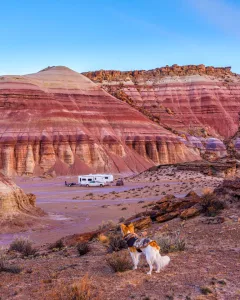
Designated off-leash areas in parks and other natural settings expand the travel opportunities for well-behaved canines.
When deciding whether your dog can remain in the RV by itself, consider its personality. Dogs can get lonely or become protective of their home on wheels, and they may bark a few times — or nonstop. It is distressing to hear an agitated dog barking inside an RV while the owners are away on a daylong adventure. Plus, subjecting campground neighbors to incessant barking is not the best way to show campground courtesy.
An RV’s interior can get very hot in the summer if it is not climate-controlled. So, this is another factor when deciding whether to leave your pup. Will it be comfortable — and safe — if it stays behind in the RV?
Another unexpected consequence is that, depending on how you camp, the dog can bring much of the outside world into the RV with them. Muddy paws, twigs, leaves, and burrs get embedded in their fur, and dust clouds fly when they shake. These are facts of life for a dog that enjoys being outdoors. We stash microfiber cloths and towels by the entry door and cover the bed with a throw blanket that we shake out before climbing in every night. We rinse Buddy’s paws in the shower, wiping up the mud afterward, and have trained him to stay by the door until he’s cleaned up.
As more people include dogs in their activities, an increasing number of businesses are taking steps to accommodate them. We’ve found that many stores tolerate or even welcome dogs. Buddy knows that behind every kiosk window or entry gate, he might meet a friendly person with a treat, and he licks his lips in anticipation of a small dish of whipped cream (a “puppaccino”) any time we go to a coffee bistro. Looking up a restaurant or park on Google Maps or a similar app and searching the reviews for the word “dog” quickly reveals whether it’s canine-friendly. Some businesses go out of their way to attract pet owners. (One high-end hotel we visited offered canine guests a welcome basket of treats!)
National parks are a different story. Although many allow you to bring a pet, specific rules vary among the facilities. Many national parks prohibit pets on trails or boardwalks, allowing them only on paved surfaces and in developed areas. So, dogs often cannot accompany you on hikes. They are usually not permitted in buildings, either. If national parks are on your itinerary, consider the restrictions.
One exception is the South Rim of the Grand Canyon. A five-mile-long paved path that welcomes leashed dogs winds along the edge of the canyon, offering one spectacular view after another. All the dogs we’ve encountered on this trail have been well-behaved during several visits there. We even met one small pup who rode in the basket of a bicycle as her owner cycled 26 miles out and back to Hermits Rest. What a ride!
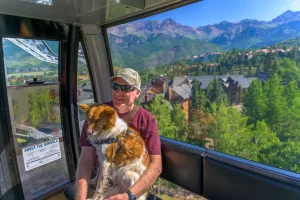
Cities offer adventures, too, such as the dog-friendly gondola rides in Telluride, Colorado.
Leaving the national park system, another jewel we discovered is Warm Springs Preserve, a 65-acre property in Ketchum, Idaho, near Sun Valley, also known as the Dog Park. Originally operated as a golf course, the property was sold to the city in 2022 and converted into a massive, dog-friendly area with towering trees, vast lawns, lovely trails, and a natural stream running through the middle.
Dogs are permitted to be off-leash throughout the park. In fact, the local canines are accustomed to the freedom and, we observed, are well-behaved. These good manners are also evident on the Trail Creek hike, where many dogs walk with their owners along a babbling brook, stopping now and then for a drink or a swim. Understandably, this is one of Buddy’s favorite destinations. An online search for “off-leash dog park in America” reveals many sites between the Great Lakes and the West Coast.
The most unusual dog-friendly experience we’ve encountered during our travels is the ski gondola rides in Telluride, Colorado. Gondolas marked with paw prints are open to four-legged passengers and their owners. Each car holds six people, and they float past awe-inspiring views. We’ve met dogs of all shapes and sizes riding the gondolas during our several visits to Telluride, and they adapt easily to the swings, bumps, and noises. It’s also a fabulous way to get to town. Park in the garage at Market Plaza in Mountain Village, then take the gondolas into downtown Telluride. A scenic, shaded walking path passes the Telluride station and parallels the San Miguel River for miles.
If you love your dog and are willing to adapt your travels to accommodate a canine companion, you and your pup will have a wonderful time RVing together. However, there’s no question that traveling without a dog is much easier and allows more freedom of choice in what you can see and do. Either way, happy trails to you, and happy tail wags to your furry friend.