
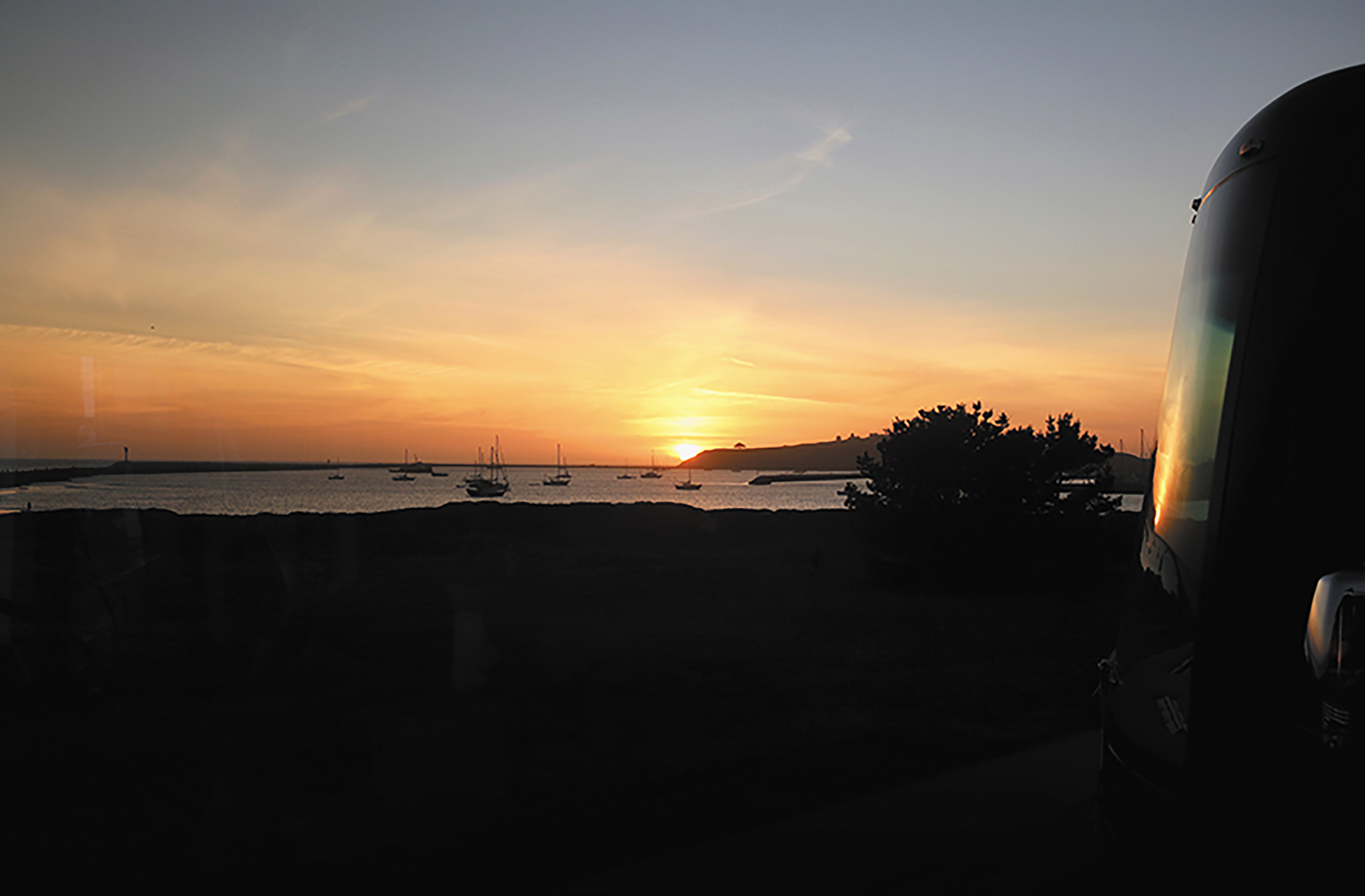
On the California coast south of San Francisco, winter RVers can enjoy spectacular views and tasty seafood.
By Bruce Davis, F440088
November 2019
A cool breeze out of the west-northwest moves across the water of Pillar Point Harbor, at Princeton by the Sea, California. The wind is just strong enough to raise a few ripples on the surface. From time to time, the dong-gong sound of the bell on the nearest channel buoy announces the long period swell of the Pacific Ocean. It’s a meditation . . . dong-gong, dong-gong . . . an ocean version of a Tibetan prayer wheel.
Drawn by a divine artist, the crisp line of the horizon marks the boundary between a blue ocean and a blue sky. Even early on this particular morning, the temperature hovers around 65 degrees. Blooming oxalis and mustard, encouraged by a few sunny days, swirl the green fields and roadsides with splotches of bright yellow. The coastal hills are already bright green.
It is darn hard to believe this is February.
The harbor areas have many recreational uses, boating among them.
Coastside Life
The folks who live here, near the hamlet of Half Moon Bay, California, and a half dozen neighboring villages, call themselves Coastsiders. And they’ll tell you that February weather often mimics what most people would call summer or spring. This particular Saturday morning, the Coastside bustles with tourists and locals out to have fun or run a few errands.
From our spot in the tiny, 49-space, tightly packed Pillar Point RV Park, 29 miles south of San Francisco, we can sit in the sun with our morning coffee and watch as a busy world passes by on the coastal path below. The morning’s assortment includes wet-suited surfers, walkers, striders, joggers, dog walkers, kid walkers, a bicyclist whose “ride” resembles a giraffe, folks carrying big buckets for the fish they’ll catch, and a few who like to sit on the bench just below our coach. Later in the morning, the breeze will bear aromas from restaurants in the harbor, evoking visions of calamari heaped high on a plate, clam chowder with sourdough bread, or a crab sandwich. Drool.
Adding the Pacific Ocean into the mix at any RV park expands possibilities in exponential fashion — an ever-increasing spiral of good things to do and, more important, good things to eat. The ocean here is cold, and the variety of marine life wondrous. Especially compared to other parts of North America. In the Midwest during Lent, the Friday fish fry holds sway, and in the desert Southwest, seafood generally means a piece of breaded cod, caught off the coast of Massachusetts and flash frozen. On this part of the Pacific coast, Dungeness crab, king salmon, squid, sole, scallops, octopus, halibut, albacore, ocean perch, sea bass, striped bass, grouper, and dozens more swim and hang out in the ocean named by Magellan in the early 16th century.
I like Friday fish-fry foods. I even like the fish and chips one can get in the Southwest. But, after a couple of months camped in the desert or in extended RVing through the Midwest, I begin craving the saltwater sea fare of my former life as a longtime Pillar Point resident.
So here my wife and I are, in a not-at-all cheap (up to $84 per night), 30-amp, water and sewer, waterfront RV park, eating fish and watching the boats sail in and out of the harbor. Within walking distance from our spot, one can gorge on fruits de mer (seafood) at Mezza Luna, Old Princeton Landing, Half Moon Bay Brewing Company, Ketch Joanne, Princeton Seafood Company, Sam’s Chowder House, and the Miramar Beach Restaurant. Farther from shore, many other seafood eateries can be found.
Fresh catches also are sold directly from the fishing boats in the harbor — everything from crab to salmon and halibut. So, cook your own. Catch your own, too! Flounder, sole, ocean perch, and rockfish lurk around the stone jetties of Princeton Harbor, and no fishing license is required. You’ll need a long pole and enough agility to jump from one car-size boulder to another — and, of course, a bucket for a bounteous catch. Or go out on one of the party fishing boats (a license is required for those).
Aside from supplying people with a gastronomic experience, marine life also can be entertainment. They star at James V. Fitzgerald Marine Reserve, just up the road in Moss Beach. At low tide, a plethora of ocean critters cling to rocks and swim in surf-washed pools formed by the remaining water.
The at-times spectacular and huge waves that crash on the reef at Mavericks, a storied beach area at the west end of the harbor, make for interesting viewing when the surf’s up. Just sitting by your RV and watching the goings-on works, too.
In the late afternoon and early evening, acting on some invisible cue, hundreds of sea birds unfold their wings and, with a few lazy pumps, lift off the jetty and rise almost straight up into the air. They have no destination. They do not dive and feed, but hover a few hundred feet above the stonework, wings partially retracted, rocking suddenly from side to side in windy, invisible eddies. This hovering flight seems without purpose, but I think they do it for the pure joy of being airborne without effort. As long as the wind races south-southwest down the coastal hills, strikes the harbor water, and then caroms straight up, the birds hover and squawk.
Paddle boarders ply the surf at Pillar Point.
How Do You Get Here?
While the Coastside in general, and Princeton Harbor in particular, are great places to be, getting in and out of the area can be vexing. Look at a map of the California coast near San Francisco, and you’ll see the little bay in which Princeton Harbor huddles. It curves around like a lazy, upside-down fish hook just north of its namesake town of Half Moon Bay. The coastal range of hills isolates most of this area from the frenetic bustle of the San Francisco Bay Area.
The ingress/egress problem is not a new one. In the early days of the last century, a group of real-estate speculators bought large tracts of Coastside property. They formed a company and built a railroad that ran from downtown San Francisco over to and along the coast and into the heart of the Coastside. They hired famous architect Daniel Burnham to lay out the new town of El Granada, which stands today. On weekends, they loaded their train with folks, hauled them down the coast, and sold them dinky lots.
Few other ways in existed. One was a toll road that ran to the bay side of the coastal range from Half Moon Bay. Another was the long trek north along the coast from Santa Cruz. That route involved wading through the surf at the foot of the Waddell Bluffs, and dodging boulders and rock slides at the same time.
The 1906 San Francisco earthquake brought the Ocean Shore Railroad to ruin when the track slid from its precarious perch and tumbled into the surf below. After extensive repairs, rail service continued for a number of years, but the disaster was never overcome, and the enterprise went into bankruptcy. That area of coastal cliff, later traversed by State Route 1, became known as Devil’s Slide. It continued moving, sliding, and isolating the Coastside from its neighbors to the north until an inland tunnel was recently constructed, leaving the slide to, well . . . slide.
Today Burnham’s concentric-circle street layout of El Granada can be clearly seen in Google Maps. The original lots were platted at just 25 feet wide, and had they all sold, the original promoters would have made a killing.
Access to Coastside’s little towns has not changed much since the Ocean Shore Railroad took a bath in the Pacific. From the north, you must use State Route 1 and its tunnel; from the east, you have to take State Route 92, with its tight turns, steepish grades, and heavy traffic. Another approach from the east is State Route 84, which has steep, tight turns, and is not recommended at all for RVs. Finally, you have the approach from the south via State Route 1. The latter is long and somewhat curvy, but it is pretty, and in winter you can stop at Ano Nuevo State Park for a look at the elephant seals.
All routes are one-lane in each direction, so a fallen tree, accident, mudslide, or even a sunny day can bring traffic to a virtual standstill. There are no alternate routes. Plan to arrive at the campground of your choosing between the morning and afternoon commute rushes. And if traffic slows or halts, relax. You’re stuck, but you’ll get there.
There is one other barrier to your Coastside sojourn: the San Francisco Bay Area. And unless you put your RV on a barge and sail in here, it is a gauntlet through which you must run. Congestion is the norm, and freeways are poorly maintained. Prices for fuel and RV parks are high. RV parts, supplies, and maintenance are difficult to find. But grit your teeth and come anyway. A three-day stay is perfect: one day to calm down after the ride in, one day to enjoy, and a third to prepare yourself for the trip out. Stay longer if your wallet will support it.
In the summertime, the Coastside is a great place to cool off. Mark Twain once said that the coldest winter he ever spent was a summer in San Francisco. Summers bring the marine layer, which is a polite euphemism for fog, and with it wet, drippy, gray-gray, sunless days. Bring sweatshirts and long pants; do not expect to spend afternoons frolicking on the beach in a bikini. From mid-June through mid-September, expect clam chowder days, huddling in a pea coat and a watch cap by the campfire.
Another great time of year to visit is late September and into October. After the summer fog lifts in the fall, beach frolics are a definite possibility, as are vistas of blue water, blue skies, and a horizon sharp as a razor blade. The fishing is always good and the food . . . well, there’s always a good meal to be had here on the Coastside. But February rates high as well; so, plan your trip now. Come, listen for the bell, and join the meditation.
The Author Rates Area Campgrounds
Bruce Davis spent many years living and working in the Half Moon Bay/Pillar Point region. Now living in a bus conversion, he has returned to the area often enough to come to the following conclusions. The ratings are his opinions only.
Pillar Point RV Park ★★★★★
Can be a challenge to maneuver through and into your space. Great views of the harbor and bay. Close to good eating, fishing, kayaking, surfing, walking. Very friendly and highly competent camp hosts who will help you pull or back in. This is a first-come-first-served park (no reservations), so check the website, which is regularly updated for availability. Or, call ahead. The 2019 fees: $67.20/partial view, $84 ocean view. Sites have 30 amps, water, sewer. A few spots on the ocean can handle 40-foot RVs. Stay limit: 28 days.
4000 Cabrillo Highway
Half Moon Bay, CA 94019
(650) 712-9277
www.pillarpointrvpark.com
Half Moon Bay State Beach ★★★★
Reservations are a must, far in advance, as the Francis Beach Campground here seems always full. Sometimes a cancellation opens a space for a day or two. Nicely spaced camping sites with paved roads and pads. Fire pits. Max length is 40 feet. Corners are tight, and tree branches drag on your roof in a few places. Sites have 50 amps. Dump station, showers. No water at campsites. 2019 rates: $50-$65 per night depending on hookups; $8 fee added for reservation; other fees may apply. Sites along the “beach” row are premium priced, but dunes obscure views of ocean or beach. Camp volunteers can be rigid.
95 Kelly Ave.
Half Moon Bay, CA 94019
(650) 726-8819; (650) 726-8820
Reservations: (800) 444-7275
Park website: www.parks.ca.gov/?page_id=531
Reservations website: www.reservecalifornia.com/CaliforniaWebHome/
Half Moon Bay RV Park ★★★
A little south of town. Another tightly packed park, which may have improved since our stay there in 2014. Paved roads and gravel campsites. Cameron’s Pub is right next door. Walk to the bluffs overlooking the ocean. Easy drive to the town of Half Moon Bay. Sites have 30 amps, water. Dump station, laundry. 2019 rates: $70 ($75 in 2020).
460 Wavecrest Road
Half Moon Bay, CA 94019
(650) 726-7275
www.hmbrvpark.com
Pelican Point RV Park ★★
Farther south of town, and down in a hole. Located near the Ritz-Carlton Hotel, but from there any comparison fails. Full hookups. Showers, dump station, laundry. Tight spaces, not very level. 2019 fee: $84 per night.
1001 Miramontes Point Road
Half Moon Bay, CA 94019
(650) 726-9100
www.pelicanpointrv.com/single-service
Santa Cruz North/Costanoa KOA ★★★★
About 25 miles south of Half Moon Bay, but just 4 miles from Ano Nuevo State Park, where you can visit elephant seals (guided walks offered mid-December through March). This is a fairly decent RV park with a restaurant on the premises. Far from most everything else, except for elephant seals. Pricey, with rates approximately $77-$115 per night.
2001 Rossi Road at Highway 1
Pescadero, CA 94060
(650) 879-7302
www.koa.com/campgrounds/santa-cruz-north/