
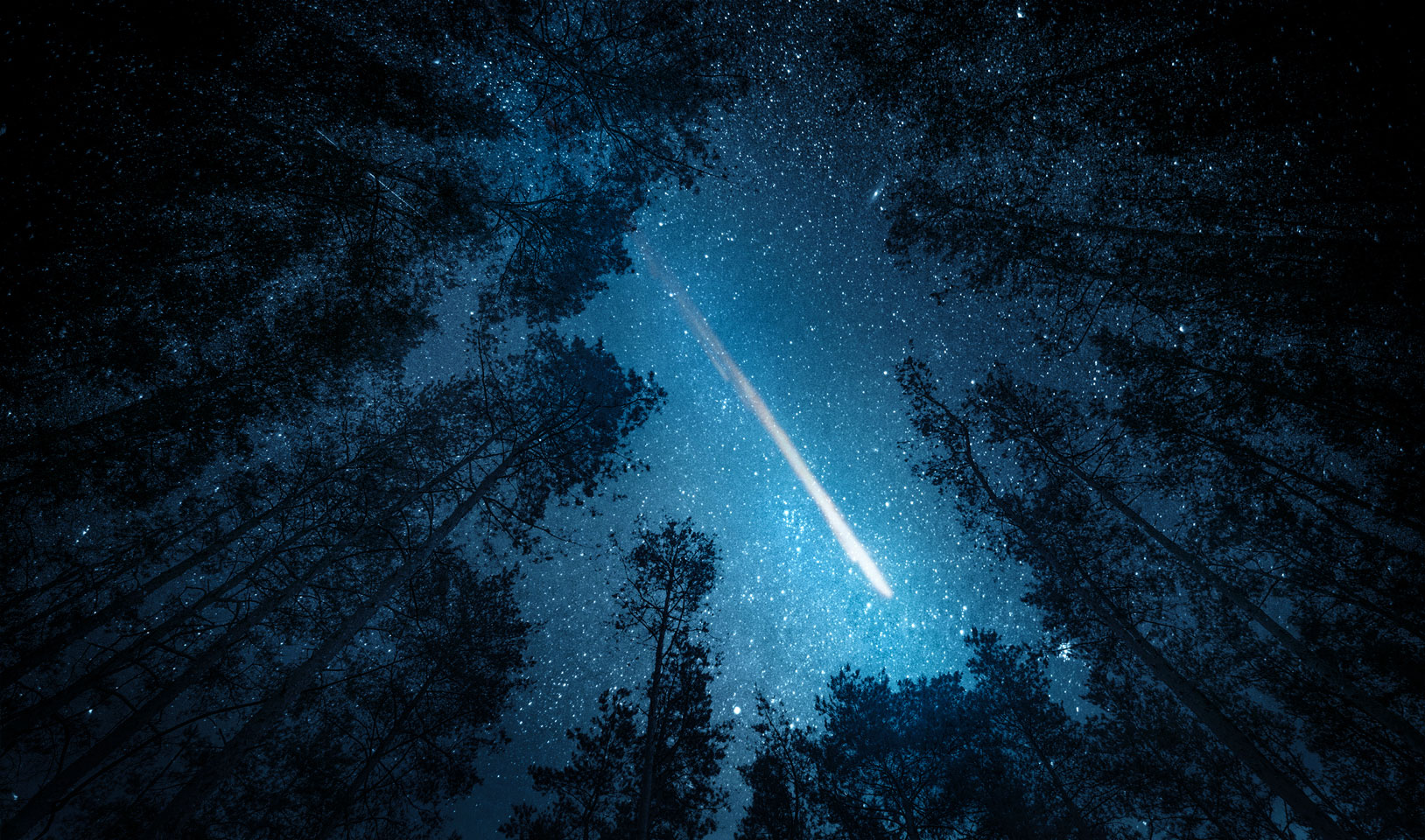
While gazing at the night sky, RV travelers can thank the seafarers and astronomers who have connected the Earth to the universe.
By Ann Bush, F516383
June 2021
As a tent camper for almost 30 years, I often removed the rain protector and spent the night snuggled in a cozy sleeping bag, mesmerized by the stars. Growing up in towns and cities, I missed the stars. The night sky above a populated community, no matter its size, is subdued by illuminated streets, cars, and buildings that create light pollution. Even in a campground, bathroom security lights, decorative lights on RVs, and cheerful campfires wipe out the brilliance of shining stars.
I didn’t fully comprehend the beauty of the night sky until — during a multifamily camping trip to Yellowstone National Park as a young teen — I saw the Milky Way for the first time. It also was my first camping trip, and I was hooked forever. Blame it on the stars, or maybe the excitement of watching a bear stroll through our campground as my mother screamed from the backseat of a securely locked car.
At present, in my tiny house on wheels, I miss the star lullaby show and stare at the ceiling, contemplating how to install a leakproof skylight.
The First Navigators
Somewhere along my journey to adulthood, I learned how sailors used stars to navigate the seas long before GPS.
About 4,000 years ago, the Phoenicians developed sea navigation tools — considered the first Western civilization to do so. Once the North Star was determined to be the most stable point in the sky, maps were created. Latitudes and longitudes were developed in the 13th century; the invention of compasses, sextants, and other instruments followed.
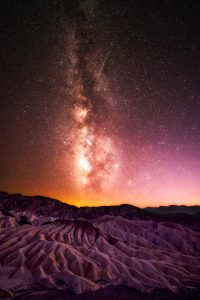
A meteor brightens Death Valley.
The sextant measured the angle between the horizon and the sun, moon, or stars in order to calculate latitude. Longitude — the difference between the mariners’ starting location and new location — changed as the ship moved. Sailors calculated the speed of the ship by comparing the distance traveled against the time it took to get there. To do this, a knotted rope attached to a wooden board was dropped over the stern as the ship was underway. The board would act as a drag, and the faster the ship went, the more rope it pulled out. A seaman would count the number of knots that were pulled out over a specific period of time.
Accuracy was a problem, as clocks in those days could lose 10 minutes easily from the jostling of the ship, translating into a computational error of 150 miles. Then in 1762, a British clockmaker invented the seagoing chronometer, which floats on a swinging base, causing less disruption to the clock’s interior system. Soon afterward, travel beyond coastlines for trade of goods and ideas followed, and the world became smaller.
Today, as road trip gurus traveling with our homes on wheels, we are a lot like mariners. We navigate routes through vast lands saturated with valleys, mountains, rivers, and lakes. Like the first sailors, we choose paths that take us to amazing places with new cultures, food, art, and entertainment. And we sometimes get lost.
Amazingly, the most beautiful, inspirational, and still mysterious part of our planet to explore is right above our heads. But, of course, to see it, we must be standing in the right place.
Where To View Our Galaxy
In 1988 the International Dark-Sky Association (IDA) was founded as a nonprofit organization committed to preserving the world’s most overlooked and endangered resources: our dark skies.
The association established the International Dark Sky Places program in 2001. Sites on the list are recognized for stringent outdoor lighting standards, community outreach, and other stewardship initiatives. The land may be privately owned and visited by invitation only, or public land with ongoing access to specific areas. The list changes as areas either lose or overcome the challenges of light pollution or providing public access. These sites are listed on www.darksky.org.
More than 130 Dark Sky Places are recognized around the world, in five categories.
In the United States, a Dark Sky Park usually means a state or federal park protected for natural conservation that implements good outdoor lighting policies and provides dark-sky programs for visitors. At this writing, 99 International Dark Sky Parks were designated worldwide, 72 of them in the United States and one in Canada. They include Antelope Island State Park in Utah; Geauga Observatory Park in northern Ohio; Joshua Tree National Park in California; and Quetico Provincial Park in Ontario.
Dark Sky Reserves consist of a dark “core” zone that is surrounded by a populated border wherein policies have been enacted to protect the darkness of the core. The core area must possess an exceptional starry night quality and a nocturnal environment. The Sawtooth National Forest in Blaine County, Idaho, hosts the only such reserve in the United States.
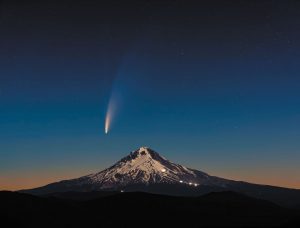
Comet Neowise orbited near Earth last July.
Very remote areas — and often the darkest — make up the list of Dark Sky Sanctuaries. Public access may be limited in order to protect a fragile condition. Seven of the 14 Dark Sky Sanctuaries are located in the United States, among them the Boundary Waters Canoe Area Wilderness in Minnesota’s Superior National Forest and Cosmic Campground in New Mexico’s Gila National Forest.
A town, city, or similar site on the Dark Sky Communities list is dedicated to preserving its night sky through outdoor lighting ordinances, community education, and citizen support of dark skies. Of the 29 Dark Sky Communities throughout the world, 23 are in the United States or Canada; these include Beverly Shores, Indiana, and Bon Accord, Alberta.
Valle de Oro National Wildlife Refuge, not far from Albuquerque, New Mexico, is one of two designated Urban Night Sky Places. Sites in this category are located near large urban areas and designed to promote authentic nighttime experiences despite abundant artificial light nearby.
Navigating A Cosmic Encounter
Now that we are in the right place and looking up, what are we looking for, or at? Our solar system is full of stars, asteroids, comets, and meteors that are leftovers from the formation of our solar system, all estimated to have been born about 4.6 billion years ago. While the planets and moons have changed over the millennia, much of the ice, rock, and metal floating in space have not, becoming a fossilized record of planetary evolution.
The most widely recognized objects in the sky for humans to see without special equipment are stars, which represent the building blocks of the galaxy. According to NASA, the age and position of each star help to trace the history of the galaxy surrounding it. Stars are born of dust particles that swirl, gathering gas and compounds in the atmosphere, which are then fueled by nuclear fusion. A dense, hot core forms, and if the soon-to-be star does not explode, it will become solid, sometimes maturing to a planet, asteroid, or comet, or will remain a simple rock.
This outflow of energy keeps the star from collapsing under its own weight. It also provides enough energy to create a shine, revealing its location and unraveling its mystery. Stars span a wide range of colors and luminosities.
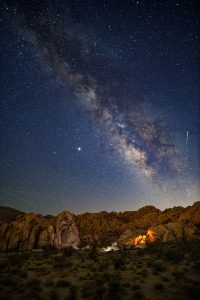
Darkness drapes Joshua Tree National Park, revealing views of the Milky Way.
At this writing, more than 1 million asteroids have been identified. Sometimes called minor planets, asteroids are rocky, airless remnants from the early formation of our solar system. They range in size from Vesta, the largest, at approximately 330 miles in diameter, to the smallest, only 33 feet across. Most can be found orbiting the sun between Mars and Jupiter, forming an “asteroid belt.”
Comets are snowballs made of free-ranging dust, rock, and ice looking for a home; they vary in size from a few miles to tens of miles wide. As they orbit closer to the sun, comets heat up and spew gases and dust from glowing foundations that can be larger than a planet. The stream of sparkling debris illuminated by the sun can stretch for a million miles or more. NASA has recorded more than 3,700 comets in our galaxy to date.
When we were children, our well-meaning parents may have told us that a streak of light through the sky was a shooting star. They also told us to make a wish, and our wish may happen. According to NASA, such “stars” are actually space rocks called meteoroids, which range in size from dust grains to small asteroids. When a meteoroid hurtles toward the Earth’s atmosphere at high speed, it burns up, forming fireballs called meteors. Almost all of the material vaporizes in the Earth’s atmosphere, leaving a trail of light as it blazes past. If a meteor remains intact and hits the ground, it is called a meteorite.
Scientists estimate that about 48 tons of meteoritic material aims for Earth every day, which can create meteor showers as it burns up in the atmosphere. Some occur annually or at regular intervals as the Earth passes through a trail of dusty debris left by a comet. The most famous are the Perseids, which peak in August every year. Every Perseid meteor is a tiny piece of the comet Swift-Tuttle, which takes 133 years to circle the sun.
Covering a large segment of the sky, the Milky Way galaxy contains Earth’s solar system. This stellar show in the sky — so named because it resembles spilled milk — is made of star clusters, nebulae, and concentrated interstellar dust clouds. It is visible from roughly February through November, depending on latitude and other factors. NASA estimates it contains between 100 billion and 400 billion stars. In 1920 Edwin Hubble provided astonishing evidence that the Milky Way is just one of countless other galaxies.
Cosmic Shopping
Then there are moons, planets, white dwarfs, yellow dwarfs (such as the sun), brown dwarfs, hypergiants, eclipses, snowflake clusters, the Aurora Borealis, novas, supernovas, black holes — all transporting earthlings through a mind-boggling cosmic superstore. Way too much information for this simple star lover! I want to keep the mystery alive, enjoy the beauty of the galaxy, be amazed by the wonder of it all, and make wishes on shooting stars.
If You Look Up
NASA (www.nasa.gov) is one of the best resources for those who love the night sky. In addition, astronomy clubs and organizations are found throughout the world; many are geographically specific, such as the Tucson Amateur Astronomy Association (http://tucsonastronomy.org). Along with NASA, these groups’ websites often offer a calendar of cosmic events.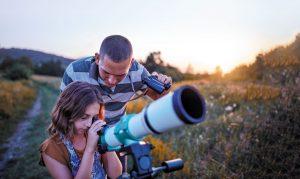
With the advancement of affordable telescopes for amateurs, “star parties” are popular and can be found by researching online or by visiting the closest planetarium.
For the best views of the night sky, remove as much light as possible. Use blue-light flashlights and let your eyes adjust to the darkness for at least 20 minutes. A telescope or binoculars will show you more detail, but for most places perfect for stargazing, they are not necessary.
And, of course, there are apps for this: Dark Sky Finder, SkyView, NASA, SkySafari, Star Rover, Cosmic Watch, Night Sky, and others.