
Weather, electronics, and poor maintenance can result in an assault on batteries. A trip to the battery bank and a few simple steps can keep your RV revved up and ready go.
By Steve Froese, F276276
August 2021
I received this email from a reader in April:
“I need to store my Class A motorhome for a month in the Reno area. The weather forecast does not call for freezing temperatures at night. I am not winterizing it. The fridge will be turned off, as will the water heater, although it will not be drained. My plan is to turn off the main battery switch right inside the door. Batteries are well charged. I’m hoping that when I return to it in three weeks, it will start right up. I’ve thought of leaving the thermostat on, set on low in case the weather changes, but I’m thinking that the propane heater will not work with the batteries turned off. Is this the right approach?”
This specific question touches upon some issues that other RV owners may face. To address it, let me begin by briefly mentioning winterization. I realize the middle of summer isn’t the time to worry about this, and this article is not about winterizing, but I would like to make a few comments about it. First, it may seem obvious, but if you live in an area that gets below freezing for more than a few nights in a row, you should consider winterizing your RV. Chasing down a leaky fitting or, worse, a ruptured hot water tank is not the way you want to spend your spring shakedown time. If you live in an area with cold winters, be sure to fully winterize your unit by blowing out the waterlines with air or adding RV antifreeze (or both). This includes draining the holding tanks and the water heater.
The reader mentions the battery switch by the door. Many motorhomes have this battery switch, which is commonly known as the battery disconnect switch. It is important to utilize this switch in times of RV storage, but it is equally important to realize in the case of motorhomes, this switch only disconnects the house battery bank and does NOT disconnect the chassis batteries. Remember, all motorhomes have two separate battery banks. One is dedicated to the house systems, such as interior lights, 12-volt devices, and appliances. The second battery bank is dedicated to the chassis, primarily to start the engine. This battery bank also typically supports the chassis systems, such as the radio, engine control module and other computer modules, exterior lights, and general coach functions such as the generator and leveling jacks.
Some motorhomes have a separate engine battery disconnect switch, which often is found in the engine bay or near the battery compartment. For motorhomes that do not have an engine battery disconnect switch, I would recommend disconnecting the negative battery terminal if the unit is to be stored for longer than a month. This may cause the onboard computer to reset and the radio to lose its memory, but these are minor issues compared to the risk of a dead battery when you go to start your motorhome for that first trip after storage. (Refer to your manufacturer’s instructions related to disconnecting the battery, as there may be steps you need to take regarding resetting the computer, etc.)
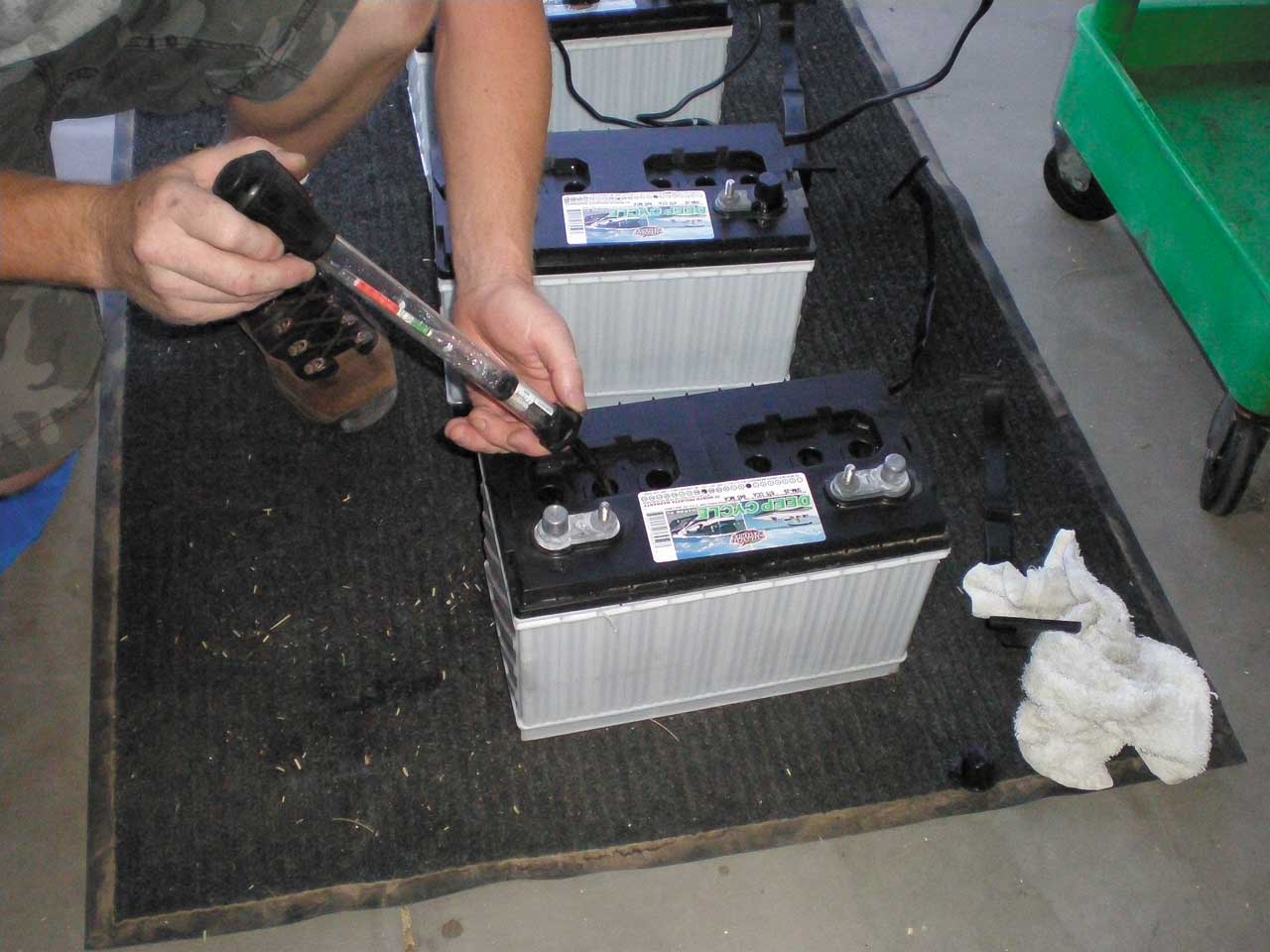
The overall condition of your batteries affects how long they last in storage, in addition to how well they hold a charge. On average, lead-acid batteries last five to seven years, and it is important to maintain them in order to maximize their life. In the case of non-maintenance-free lead-acid batteries, be sure to check the specific gravity (SG) of the batteries every few months. Basic battery hydrometers that test the state of charge in a battery’s cells are inexpensive, accurate, and a necessary tool for any RV toolbox. There is no need to purchase more expensive glass types or refractometers.
Wearing eye protection and gloves (avoid splashing the electrolyte and getting it on your clothes), carefully remove the battery caps and ensure the electrolyte level is full in each cell. Top it off with distilled water if necessary. (Note that if you just added electrolyte or charged the battery, you should wait an hour or so before taking SG readings.) Dip the hydrometer tube into each cell, draw the electrolyte up to the fill line, tap to release any bubbles, hold the instrument completely vertical, and take note of the reading.
The specific gravity reading of each cell is not as important as making sure that each cell has a similar reading. The actual SG level varies depending on the state-of-charge (SOC) of the battery, but each cell should have relatively the same SG reading. (See the table below for a SG vs. SOC comparison.)
Charged | Specific Gravity
100% | 1.255-1.275
75% | 1.215-1.235
50% | 1.180-1.200
25% | 1.155-1.165
0% | 1.110-1.130
Be sure to return the electrolyte to the same cell. If you find the SG reading is not the same across all cells, the battery should be replaced, even if only one cell is different. And always replace all batteries in each bank at the same time.
When storing batteries for the winter, be sure they are fully charged, as the higher the battery SOC, the less likely the electrolyte is to freeze. A fully charged battery will not freeze until 40 degrees below zero, while a dead battery will freeze at around the freezing mark — 32 degrees Fahrenheit or zero degrees Celsius.
Turning our attention back to the disconnect switch(es), note that turning them off will NOT generally remove all loads from the batteries. Some loads are either connected directly to the battery or connected to the battery side of the disconnect switch. In the case of the house battery bank, the propane detector generally is wired to the battery side (some coaches have separate disconnect switches for the propane detector). For the engine, the computers and/or radio memory may not be wired through the disconnect switch, so turning off the disconnect switches may still result in a parasitic load on the battery. For extended periods of storage, it is recommended that you disconnect the negative battery terminal or remove the batteries.
If you have solar panels, it is worth checking to see whether the charge wires are connected directly to the battery. That way, setting the disconnect switch still allows your batteries to charge from your solar panels. If you live in an area that has reasonable solar energy hitting the panels, solar is a great way to keep your RV batteries charged during idle periods; however, winter weather and atmospheric conditions do limit the amount of charge reaching your batteries. In any case, regularly checking the battery condition is recommended, whether they are in the RV or removed for storage. As mentioned, check the electrolyte level and SG of your batteries every few months. Also be sure to keep the batteries clean, including the posts and case.
Regarding the reader’s final point, it is true that the furnace does not work with the batteries disconnected. If the RV is properly winterized, there is no need to keep the heat on. If you do choose to keep your furnace running at a low temperature to keep the chill off, it is recommended that you plug your coach into shore power, as a furnace can drain your battery very quickly. Again, solar can help in this regard, but note that a furnace is a large current draw, and the solar energy may not be able to keep up. As a final note, travel trailers also may have a battery disconnect switch. If present, the switch for travel trailers is located either on the inside of the A-frame near the battery or in a front storage compartment. For fifth-wheels, it is usually in a front compartment but may be inside the unit.
Send Your Troubleshooting Questions to Steve Froese at techtalk@fmca.com. The volume of correspondence may preclude personal replies. Not all responses will apply in every instance. Some situations may require a visual inspection and hands-on testing. If you choose to follow any procedures outlined in this column, first satisfy yourself that neither personal nor product safety will be jeopardized. If you feel uncomfortable about a procedure, stop and make an appointment with an RV service facility.