
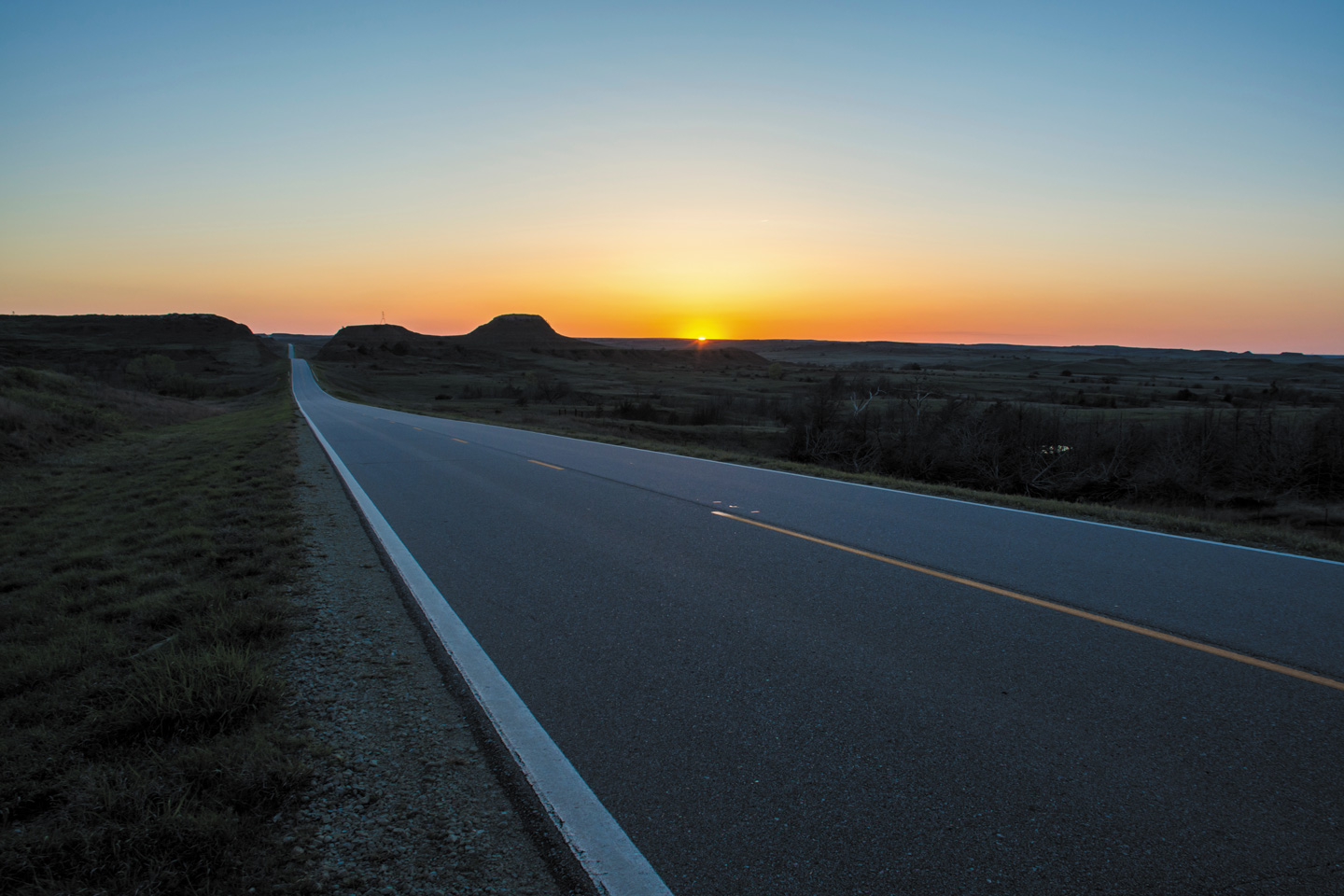
Discover natural beauty, history, and a wealth of attractions along designated state and national scenic byways in the Sunflower State.
By Ann Bush, F516383
December 2021
Home, home on the range
Where the deer andthe antelope play
Where seldom is heard a discouraging word
And the sky is not cloudy all day.
Sometimes called the “unofficial anthem” of the American West, Home On The Range started as a poem written by Dr. Brewster M. Higley of Smith County, Kansas. Written in approximately 1872 and titled “My Western Home,” the poem was penned in praise and love of the Kansas prairie. It went on to become one of the top Western songs of all time, and in 1947 it was designated the state song of Kansas. Higley’s small cabin in Smith County, Kansas, the site where the poem was written, still overlooks the prairie and is listed on the National Register of Historic Places.
Most people traveling through Kansas never leave the freeway, setting cruise speed to the max and daydreaming through fields of wheat, corn, and sunflowers. During one of my road trips across America this summer, I exited the freeway and explored several of the designated Kansas Byways. The state has 12 distinctive byways — nine scenic byways and three historic byways. The routes vary in length and direction, starting near the western Kansas border and drifting across to the eastern state line.
Wildflowers adorn the Land & Sky Scenic Byway.
Land & Sky Scenic Byway
Travelers along this route in western Kansas experience the Great Western Cattle Trail and the rugged landscape of the Arikaree Breaks. In the distance — on a private ranch but open to visitors — is Mount Sunflower, the highest point in Kansas, at 4,039 feet. The byway stretches 88 miles along Kansas Highway 27 from Sharon Springs north to the Kansas-Nebraska state line. It features thousands of farm fields rotating with wheat, livestock, and wildflowers and resembling a patchwork quilt.
Smoky Valley Scenic Byway
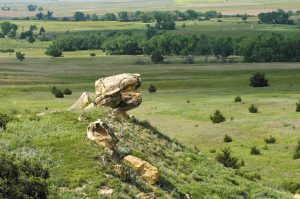
Rock outcroppings from an ancient sea along the Smoky Valley Scenic Byway.
Named because of the haze that appears at sunrise and sunset, this U-shaped route traverses 60 miles in west-central Kansas (U.S. 283; Kansas highways 4 and 147). It leaves the tallgrass prairie behind and offers a 360-degree view of wild-flowers mingled with wheat fields. Rock outcroppings hint at the stone beneath the surface that supported a sea millions of years ago. Early pioneers bound for the Wild West traveled this same path on the Smoky Hill Trail, often carving their names in the canyon walls. Cedar Bluff State Park, located off Highway 147, is worth a visit, named for the 100-foot-tall cedar-covered limestone bluffs along the southern side of the park’s reservoir. Nearby is Threshing Machine Canyon, the site of an 1867 American Indian attack on a wagon transporting a threshing machine to Brigham Young in Salt Lake City, Utah.
Post Rock Scenic Byway
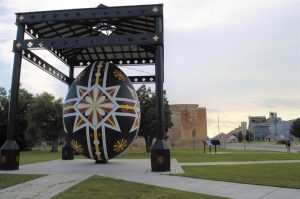
The world’s largest hand-painted Czech egg in Wilson, along the Post Rock Scenic Byway.
In north-central Kansas, the deer and antelope roam freely on the prairie, but livestock cannot. With few trees available during the homesteading days, fence posts were made from the stone under the settlers’ feet. The same innovative pioneer spirit soon shaped the limestone into slabs used for homes and roads. Many of these rock posts remain, creating a unique landscape. They inspired the name of this 18-mile scenic byway, which winds north and south on Kansas Highway 232 and links the communities of Wilson and Lucas. Wilson Lake is the highlight of the route, attracting more than 225 species of birds in a year’s time to the reservoir, state park, and wildlife area.
I visited the small town of Wilson and the Midland Railroad Hotel, built in 1899 and beautifully renovated. Across the street from the hotel stands the world’s largest hand-painted Czech egg. The hotel offers fine dining, and the locals say the Czech Festival is a big hit every July.
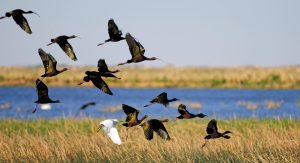
Millions of birds migrate through the Cheyenne Bottoms Wildlife Area, along the Wetlands & Wildlife National Scenic Byway.
Wetlands & Wildlife National Scenic Byway
For wildlife lovers, this state- and nationally designated scenic byway is a wonderful off-the-beaten-path trip. This 77-mile byway twists and turns its way through small, rural south-central Kansas communities, stretching from Hoisington in the north to St. John in the south. Within the route are two marsh-lands that attract hundreds of thousands of migrating birds each year — Cheyenne Bottoms, which is the nation’s largest inland marsh, and the Quivira National Wildlife Refuge, a rare habitat of salt marshes.
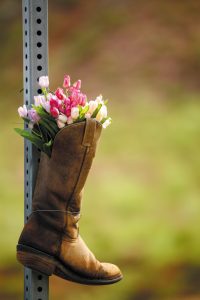
A fun Western touch on the Gypsum Hills Scenic Byway.
Gypsum Hills Scenic Byway
Nestled in the grasslands of southern Kansas are the Gypsum Hills, sometimes call the Red Hills, bulging with geologic diversity and simple prairie beauty. The 42-mile scenic route traverses U.S. Route 160 from Medicine Lodge west to the junction of U.S. Route 183 in Coldwater. The drive offers views of a rocky landscape and two scenic overlooks that are great spots to watch the sun disappear over the smooth horizon. Roll down the window and sniff a sweet freshness not found in the big cities.
Prairie Trail Scenic Byway
Following the steps of American Indians, Spanish explorers, pioneers, and thousands of bison, the winding, 80-mile route in north-central Kansas begins just south of Canton and ultimately ends at the intersection of U.S. Highway 156 and I-70. The route is close to the famous Chisholm Trail, used during the 19th century to drive cattle from Texas to points north, including Kansas. Zebulon Pike and “Buffalo Bill” Cody were among the famous visitors to this area. Other travelers included immigrants from Sweden who settled in the area, bringing their masonry skills, which are evident in the homes they built.
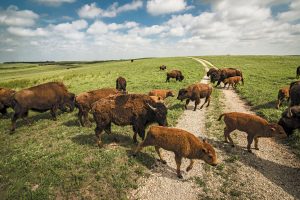
Bison roam in Maxwell Wildlife Refuge, accessible via the Prairie Trail Scenic Byway.
I also explored two very nice state parks along the byway, both worth a stop — Mushroom Rock State Park and Kanopolis State Park, the latter of which was very popular with RVers.
I turned off the radio and listened to the western meadowlark’s gifted song as I steered with leisure through the prairie.
Native Stone Scenic Byway
Limestone is the bedrock of Kansas, used in the construction of many buildings and landmarks. This nearly 75-mile route in the northeast quadrant of the state wends its way along state highways 4 and 99, between the communities of Alma and Dover; continues on Highway 99 and then heads west on Kansas Highway 18; and finally travels south on Kansas Highway 177, ending at the junction of Interstate 70. It highlights both the natural wonder of rock formations popping out of flat farmland and the amazing craftsmanship of masons who built the small towns along the route using this native stone. Slow down through these rural towns to watch for city halls, courthouses, and steepled churches that exhibit marvelous examples of masonry.
Flint Hills National Scenic Byway
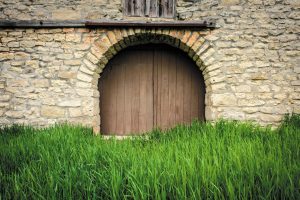
Native limestone structures dot the Kansas prairie, including this barn along the Flint Hills National Scenic Byway.
On the eastern side of Kansas is a landscape so rare that the route also is recognized on a national level. The Flint Hills of Kansas offer incredible views of native grasses and wildflowers, with the landscape appearing much as it did thousands of years ago. One of the last remaining undisturbed prairie landscapes in the United States, this area is protected as the Tallgrass Prairie National Preserve. Other places worth a stop along the way are Kaw Nation Heritage Park and Kaw Mission State Historic Site. The 47.2-mile byway travels Kansas High-way 177 between Council Grove and Cassoday in east-central Kansas.
Glacial Hills Scenic Byway
In the northeastern corner of Kansas, the prairie transforms into rolling hills and rock-strewn valleys carved by ancient glaciers. The receding ice left fertile farm-land that was heavily populated by American Indians when Lewis and Clark celebrated Independence Day on July 4, 1804, along their journey. The 63-mile byway begins at the intersection of state highways 7 and 92 in Leavenworth and ends in White Cloud near the Kansas-Nebraska-Missouri border. It includes historic Pony Express routes and the spot where Abraham Lincoln delivered one of his most famous campaign speeches. Years later, Amelia Earhart would grow up in the area and become a renowned aviator. Her childhood home in Atchison is now a museum. A nice stop along the way is Fort Leavenworth — the oldest Army post in continuous existence west of the Mississippi River.
History And More
Kansas also boasts three byways with a historic focus: Western Vistas Historic Byway, Frontier Military Historic Byway, and Kansas Historic Route 66 Byway.
Plus, the state has much more to explore. Kansas City arguably offers the best steaks in America; distilleries supply tantalizing refreshments using only Kansas-grown grains; miles of rivers and streams beckon kayakers; and a pancake race takes place in Liberal, Kansas, a city that also features a replica of Dorothy’s home from Wizard of Oz.
If You Go
I found good information, including a byway event calendar and videos, on the www.travelks.com website. Visitors can order a free Kansas travel guide, as well as a Kansas scenic byways guide, via the website or by calling (785) 296-2009. But, most important, before you leave your house, know all the words to Home On The Range, and be prepared to sing the song at a moment’s notice. It’s a requirement for those who crisscross Kansas.